Can ChatGPT check for plagiarism?
What ChatGPT can and cannot check
Not reliably. A plagiarism checker compares your paper with a set of sources and links every match. ChatGPT writes answers from patterns in its training data, and OpenAI says it can make up quotes and citations. OpenAI also says ChatGPT cannot reliably tell whether text was written by AI. Use a plagiarism checker for copied text and an AI detector for AI writing.
Can ChatGPT detect plagiarism?
ChatGPT can read your text and give an opinion. The OpenAI pages we read do not describe a check that compares your paper with a set of sources and marks each match, which is what a plagiarism checker does.
A plagiarism checker cuts your paper into short runs of words, looks for the same runs in its sources, and links each match to the page or paper it came from. How plagiarism checkers work explains the method step by step.
OpenAI describes ChatGPT differently. With web search on, which OpenAI says is the default, ChatGPT can look up information on the web. Without it, answers come from what the model learned in training. OpenAI does have a Plagiarism Checker by ChatGPT page that says: “Paste your writing into ChatGPT's plagiarism checker to check for potential plagiarism and review originality in seconds.” The OpenAI pages we read do not say which sources it compares your writing with, or how it gives a score.
“ChatGPT is designed to provide useful responses based on patterns in data it was trained on. But like any language model, it can produce incorrect or misleading outputs.”
| ChatGPT | My Paper Plagiarism Checker | |
|---|---|---|
| What it reads your paper against | Patterns from its training data, plus web search when that tool is on. | English Wikipedia, academic papers found through OpenAlex and papers checked on My Paper Plagiarism Checker before. Web pages are being added. |
| What it gives you | A written answer. | A similarity score, each matching passage marked in your paper, and the source of each match. |
| Sources it names | OpenAI says it can produce “Fabricated quotes, studies, citations or references to non-existent sources”. | Each match links to its source, so you can open it. |
| AI writing | OpenAI says it can't reliably tell whether text was AI-generated. | An AI score and highlighted sentences, as a signal to review. |
Why ChatGPT can make up sources and matches
ChatGPT predicts text. When it names a source, the source can be wrong or may not exist.
OpenAI calls this a hallucination. Its help center lists “Fabricated quotes, studies, citations or references to non-existent sources” as one example, and advises: “Always verify quotes, data, technical information or references to external documents.”
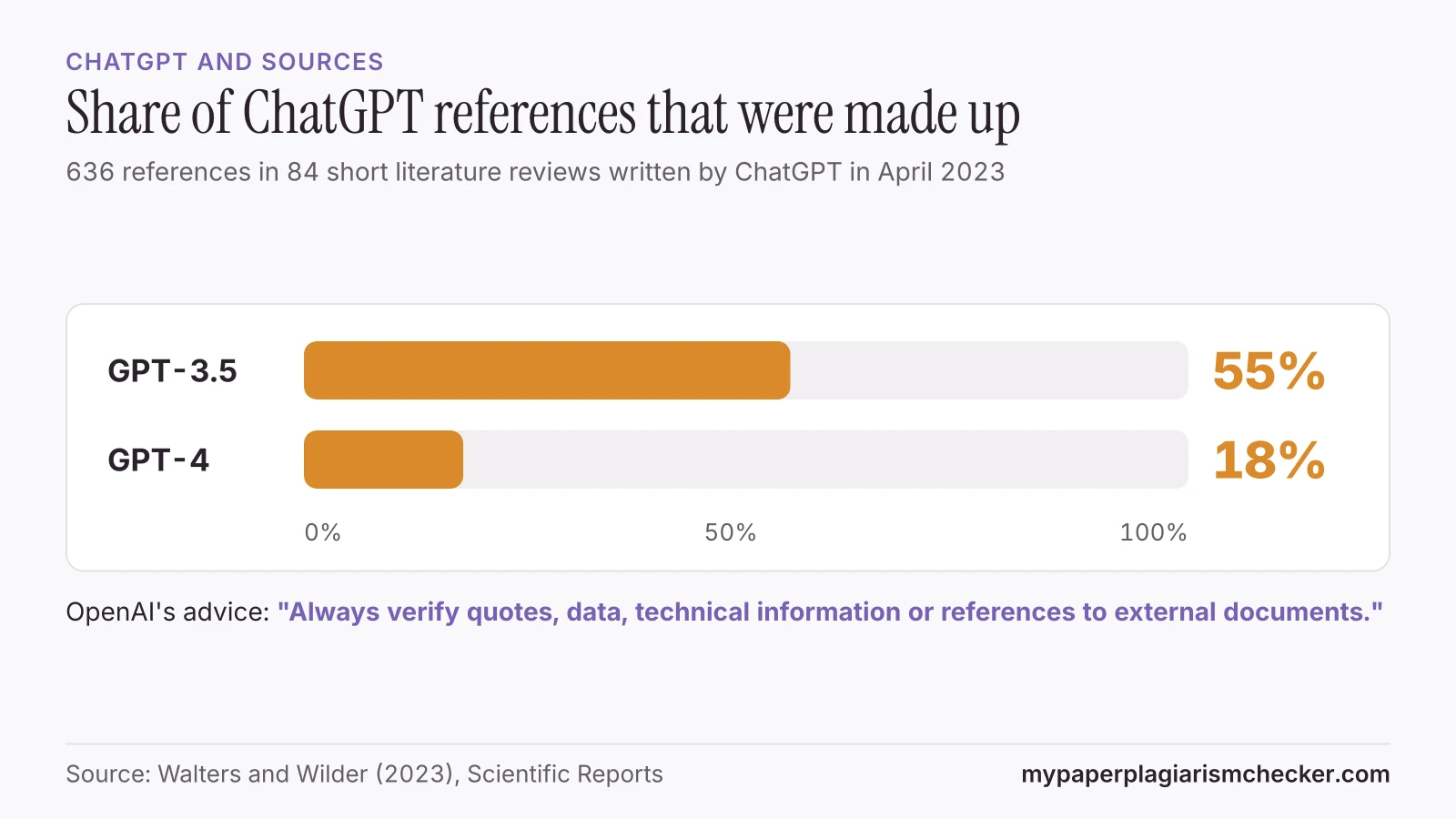
A 2023 study in Scientific Reports asked ChatGPT for 84 short literature reviews in April 2023 and checked the 636 references they cited. It found that 55% of the GPT-3.5 references and 18% of the GPT-4 references were fabricated. The authors also note that ChatGPT often gives wrong answers when asked whether the works it cited are real.
So if ChatGPT tells you a sentence comes from a source, or that your paper is original, you cannot tell from the answer alone. Open the source and compare the words yourself.
Can ChatGPT detect AI writing?
No. OpenAI says ChatGPT cannot reliably tell whether a text was written by AI, including text it wrote itself.
“ChatGPT can't reliably determine whether text was AI-generated or whether it wrote the text. It may make up answers to questions such as ‘Did you write this essay?’ or ‘Could this have been written by AI?’ Those answers are not reliable evidence of authorship.”
“ChatGPT has no ‘knowledge’ of what content could be AI-generated. … These responses are random and have no basis in fact.”
Students still ask it. One wrote on r/Grammarly: “I asked ChatGPT ‘did you write this’ and it blunt out said ‘Yes, this is 80 to 90% LLM output.’” By OpenAI's own account, an answer like that is not evidence either way.
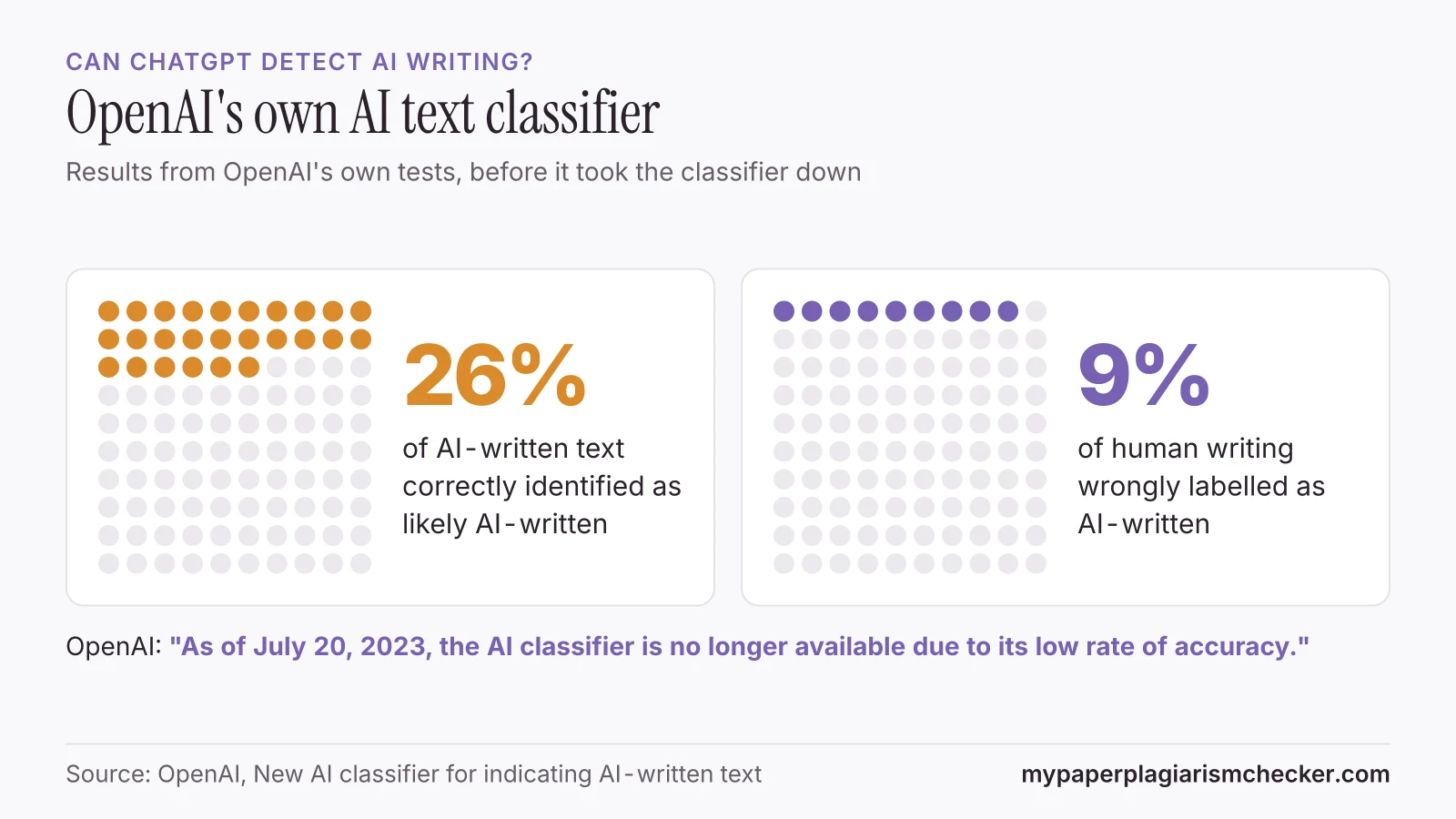
OpenAI also built a separate AI text classifier in 2023 and took it down. Its note says: “As of July 20, 2023, the AI classifier is no longer available due to its low rate of accuracy.” In OpenAI's tests it caught 26% of AI-written text and labeled human writing as AI 9% of the time. OpenAI's educator FAQ adds that its detector labeled Shakespeare and the Declaration of Independence as AI-generated, and that it could disproportionately affect students learning English as a second language.
A purpose-built AI detector for students gives a score and highlights the sentences that read as AI-written. That is still a signal to review, never proof. If your own writing is being flagged, see why your writing gets flagged as AI.
What to use instead of ChatGPT
Use a plagiarism checker for copied text, an AI detector for AI writing, and your own eyes for citations.
A plagiarism checker
It marks each passage that matches a source and links the source, so you can quote and cite it or rewrite it.
An AI detector
It highlights sentences that read as AI-written. If a highlighted sentence is your own, keep it, and keep your drafts.
Check citations yourself
Open every source ChatGPT names before it goes in your reference list.
Our plagiarism checker for students runs both checks on the same text in one report. It finds copied runs of 10 or more words, including light edits, and does not yet catch a passage that has been fully reworded. If your school uses Turnitin, read what a pre-check can tell you on our Turnitin alternative page. If you are choosing between checkers, see our Grammarly plagiarism checker alternative page, or pricing and features for longer papers.
FAQs about ChatGPT and plagiarism
Can ChatGPT run a plagiarism check?
It can read your text and comment on it, and OpenAI has a "Plagiarism Checker by ChatGPT" page. The OpenAI pages we read do not say what sources it compares your text with, and OpenAI says ChatGPT can make up citations. Use a plagiarism checker that links every match to its source.
Can ChatGPT detect AI writing?
No. OpenAI says ChatGPT can't reliably determine whether text was AI-generated or whether it wrote the text. Its answers to "Did you write this?" are not reliable evidence.
Does ChatGPT cite its sources?
With web search on, ChatGPT can give cited answers. Without it, answers come from patterns in its training data. OpenAI lists fabricated citations among the mistakes it can make, so open every source before you use it.
Can Turnitin detect ChatGPT?
Turnitin sells AI writing detection as an add-on that schools license, and only instructors and administrators see the result. Its score is a signal for your instructor to review. See our Turnitin alternative page for what students can check first.
Is a plagiarism check accurate?
It is good at finding copied text and weaker at reworded text. A match shows shared wording. Whether it is plagiarism depends on whether you quoted and cited it.
Is my paper stored if I check it here?
Yes, until you delete it. My Paper Plagiarism Checker keeps your paper with its report so later papers checked here can be compared with it, and those matches never show your name. It is not sent to your school or to Turnitin.
Sources
- OpenAI Help Center: Does ChatGPT tell the truth?
- OpenAI Help Center: How can educators respond to students presenting AI-generated content as their own?
- OpenAI: New AI classifier for indicating AI-written text
- ChatGPT: Plagiarism Checker by ChatGPT
- Walters and Wilder (2023): Fabrication and errors in the bibliographic citations generated by ChatGPT (Scientific Reports)
Pages read 13 November 2026
Check your paper before you hand it in
Free up to 3,000 words. No card needed.