
What is a good Turnitin score?
Reading your similarity score
There is no single good similarity score. Turnitin says every school, instructor or assignment can accept a different amount of matching text, so the limit that counts is the one your course sets. This guide shows how to read the number and what to fix.
What a similarity score measures
A similarity score is the percentage of your paper that matches text in other sources, from 0% to 100%.
The score counts matching words. It does not decide whether those words are plagiarism: a correctly quoted and cited sentence can match a source, and so can your reference list. That is why two papers with the same score can need very different fixes. The score adds up the matched passages, each linked to its source, as the sample plagiarism report shows. You see a score like this when you run a plagiarism checker for students before you submit, or when your school runs Turnitin.
“Even when a submission has quotation marks and references, the quoted text will show as a match. The similarity score is simply the percentage of text in a submission that matches other sources.”
“Turnitin does not check for plagiarism in writing. We do check all submissions against our database.”
What is a good Turnitin score?
There is no fixed good score. Each school, instructor or assignment sets its own acceptable amount of matching text, and some set none at all.
“There is no fixed number to receive as a score in your Similarity Report. Every school, instructor, or assignment could have a different amount of matching text that is considered acceptable.”
Turnitin's student guide gives three things to do before you submit:
- “Consult your class syllabus, check assignment instructions, or ask your instructor for similarity score expectations.”
- “Review your institution's policies on what counts as an acceptable similarity score.”
- “Properly cite each source that you reference.”
What universities say about similarity scores
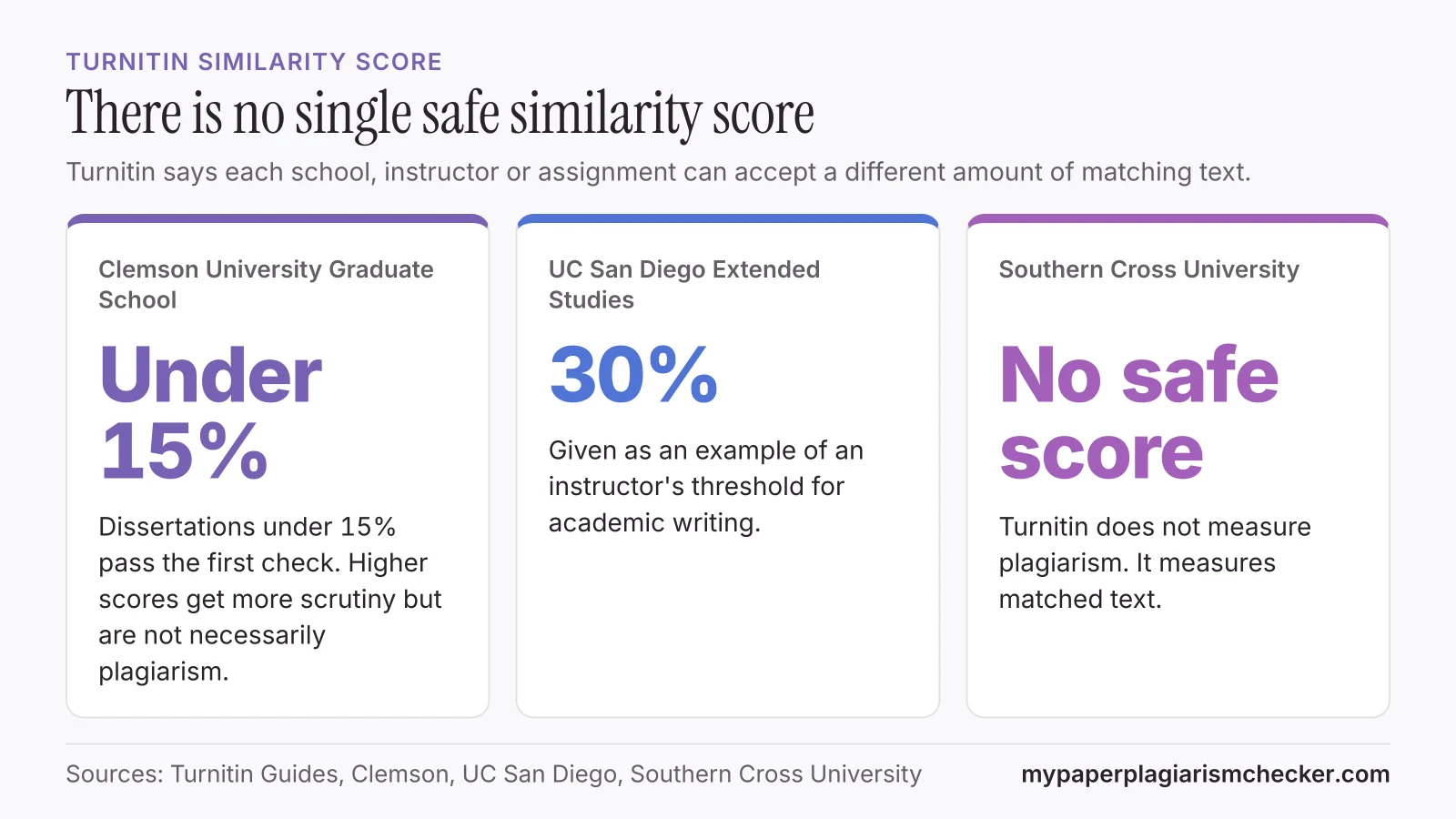
Policies differ. One university uses 15% as a first filter for dissertations, one leaves the limit to each instructor, and one says no score is safe.
| University | What its page says | Source |
|---|---|---|
| Clemson University, Graduate School (dissertations, checked with iThenticate) | Typically, similarity scores below 15% are considered to have passed the check and do not require further evaluation. Higher scores are subject to more scrutiny but are not necessarily considered plagiarism. | Plagiarism, Graduate School |
| UC San Diego Extended Studies | if you score above your instructor's stated threshold (E.g., 30% for academic writing), then you will need to address the problematic areas indicated by Turnitin. | How to view your Turnitin plagiarism score |
| Southern Cross University (Australia) | There is no ‘safe’ Similarity Score that says your work is free of plagiarism. This is because Turnitin does not measure plagiarism. It measures matched-text. | Academic Integrity, Turnitin, and Gen AI |
Clemson's page also says: “There is no set threshold for what is considered plagiarism, and each match is evaluated for context, and every situation is unique.” Even where a number is used, a person still reads the matches.
What do the Turnitin similarity colors mean?
Turnitin colors the score by how much text matched. Its student guide lists two color sets, depending on which Turnitin product your school uses.
Feedback Studio
- BlueNo matching text
- GreenOne word to 24% matching text
- Yellow25-49% matching text
- Orange50-74% matching text
- Red75-100% matching text
Similarity and SimCheck
- Green0% matching text
- Blue1-24% matching text
- Yellow25-49% matching text
- Orange50-74% matching text
- Red75-100% matching text
Turnitin adds: “The color scheme used for similarity scores may vary depending on the integration.” The colors describe the amount of matching text. They are not a grade and they do not mark a pass or fail line. Source: Understanding the similarity score for students.
Is 20%, 25% or 30% similarity too high?
It depends on what matched, and on your school's limit. A 30% score made of cited quotes and a reference list can be fine. A 10% score made of one copied paragraph with no citation is a problem.
Turnitin's student guide puts it this way: “A high similarity score does not always suggest that a piece of writing has been plagiarized, just as a low similarity score does not always indicate that no plagiarism has occurred.”
Why your score can be high when you did not copy
Quotes
In Turnitin, quoted text shows as a match unless the report is set to leave quotes out.
Your reference list
Papers that cite the same source in the same style share the same reference entry.
Earlier drafts
Turnitin says drafts submitted to your school's private repository can make the final draft score 100%.
Common phrases
Set terms and standard phrases in your subject match by chance.
Your name or a template
A cover page or class template can match other students' papers that use the same one.
Many short sources
Lots of small matches across many sources can add up to a large total.
Turnitin's filters can leave out quotes, the bibliography and small matches, and your instructor chooses which ones are on. In the newer report, Turnitin says: “By default, the threshold is 8 words, meaning that only matches 8 words or longer appear in the Similarity Report.” Source: How exclusion filters refine the Similarity Report.
What a 0% similarity score means
A 0% score means no matching text was found, or the matches were too small to reach 1%. Turnitin notes that a long document “could result in a 0% similarity score with a report that still contains matches”, because the score was rounded down. It also says: “Zero similarity may indicate that you aren't including any source-based evidence, a requirement for many assignments. Some similarity is expected.”
What counts in your My Paper Plagiarism Checker similarity score
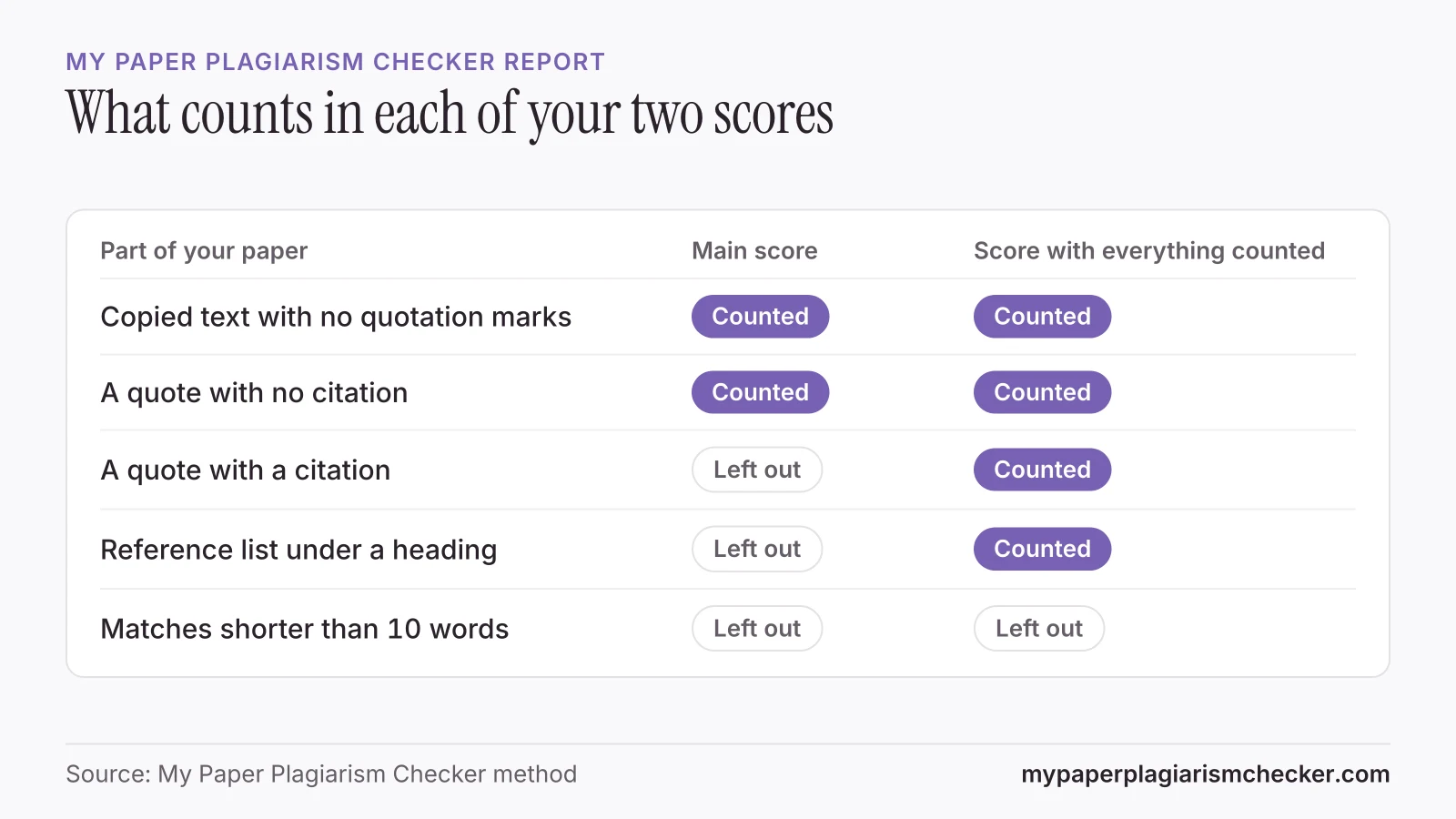
Quotes with a citation and a headed reference list are left out of your My Paper Plagiarism Checker score. Quotes with no citation are counted and flagged.
A quote counts as cited when a citation sits next to it, such as (Smith, 2020), (para. 4), [3] or Smith (2020), or when the sentence introduces it with “according to”. Double quotes, single quotes and indented block quotes are all handled. The report also shows a second score with quotes and references counted, in case your school counts them.
| Part of your paper | Main score | Score with everything counted |
|---|---|---|
| Copied or closely edited text with no quotation marks | Counted | Counted |
| A quote with no citation | Counted Flagged when it is 8 words or longer | Counted |
| A quote with a citation | Left out | Counted |
| Reference list under a heading such as References or Works Cited, in the second half of the paper | Left out | Counted |
| Matches shorter than 10 words | Left out | Left out |
If more than 15% of your paper is inside quotation marks, the report warns you about heavy quoting, even when every quote is cited. For the full method, see how we check papers.
How to read your similarity report
Start with the biggest source, open each highlighted passage, and decide what kind of match it is.
Look at the sources list
Each source has its own percentage, largest first. One large source usually means one long passage to look at.
Open each highlighted passage
Compare your sentence with the source wording. Check whether it is a quote, a paraphrase or a common phrase.
Read the warnings
A warning means a quote of 8 words or more has no citation, or more than 15% of the paper is quoted.
Compare the two scores
The gap between the main score and the score with everything counted comes from your cited quotes and reference list.
What to fix before you submit
Open each match, then cite it, quote it or rewrite it in your own words, and check again.
Copied wording
Add quotation marks and a citation, or rewrite it from your notes.
Close paraphrase
Close the source and write the idea again in your own words. Cite the source.
Quote with no citation
Add the author and year, page or paragraph number your style guide asks for.
Too many quotes
Keep the quotes that matter and explain the rest in your own words.
Cited quotes and references
Leave them. They are correct use of sources.
Check again
Run the check after your edits to confirm the matches are gone.
Turnitin's advice for a high score is to “Balance the information that you use from texts with your own writing.” If your school also runs an AI check, the AI detector for students reads the same text and highlights the sentences that read as AI-written.
Why My Paper Plagiarism Checker and Turnitin give different scores
The two checkers search different sources and treat quotes and references differently, so the numbers will not match.
Turnitin says its database “includes current and archived content from the internet, thousands of periodicals, journals, and publications, as well as a repository of works other students have submitted to Turnitin.” My Paper Plagiarism Checker cannot search that student repository. Each checker searches different sources, so a Turnitin alternative will not give Turnitin's number. Your instructor also picks Turnitin's filters, so the same paper can score differently in two classes.
Turnitin is sold to schools and other institutions. Its help center says: “Turnitin does not sell individual licenses or single-use subscriptions.” A pre-check on My Paper Plagiarism Checker shows you which passages need a citation or a rewrite while you can still edit. My Paper Plagiarism Checker is not affiliated with Turnitin.
FAQs about similarity scores
Is 25% on Turnitin bad?
Not by itself. A 25% score made up of cited quotes and a reference list is very different from 25% of copied sentences. Open the report, see what matched, and compare the score with the limit your course sets.
Is 15% a safe similarity score?
There is no score that is safe everywhere. Clemson University's Graduate School treats dissertations under 15% as having passed its first check, while Southern Cross University says there is no safe score at all. Your own school's rule is the one that applies.
Do quotes count in a similarity score?
In Turnitin, quoted text still shows as a match unless the report is set to leave quotes out. In My Paper Plagiarism Checker, quotes with a citation are left out of the main score, and quotes with no citation are counted and flagged.
Can I see my Turnitin similarity score?
Only if your instructor allows it. Turnitin's student guide lists "Your instructor turned off student access to the Similarity Report" as one reason a score may not appear.
Does a high similarity score mean plagiarism?
No. A score only measures matching text. Turnitin's own guide says a high score does not always mean plagiarism, and a low score does not always mean there was none.
Will My Paper Plagiarism Checker give the same score as Turnitin?
No. The two checkers search different sources and treat quotes and references differently, so the numbers will not match. Use your My Paper Plagiarism Checker report to find and fix problems before you submit.
Sources
- Turnitin Guides: Understanding the similarity score for students
- Turnitin Guides: Understanding the similarity score
- Turnitin Guides: How exclusion filters refine the Similarity Report
- Turnitin Help Center: Can I purchase an individual Turnitin license?
- Clemson University Graduate School: Plagiarism
- UC San Diego Extended Studies: How to view your Turnitin plagiarism score for an assignment (Students)
- Southern Cross University: Academic Integrity, Turnitin, and Gen AI
Pages read 12 November 2026
Check your paper before you hand it in
Free up to 3,000 words. No card needed.