
How plagiarism checkers work
How we check papers on My Paper Plagiarism Checker
A plagiarism checker breaks your paper into short runs of words, looks for the same runs in its sources, and reports how much of your paper matches. This page explains the method in plain terms, then shows exactly how My Paper Plagiarism Checker checks a paper and what it cannot catch yet.
How a plagiarism checker finds matches
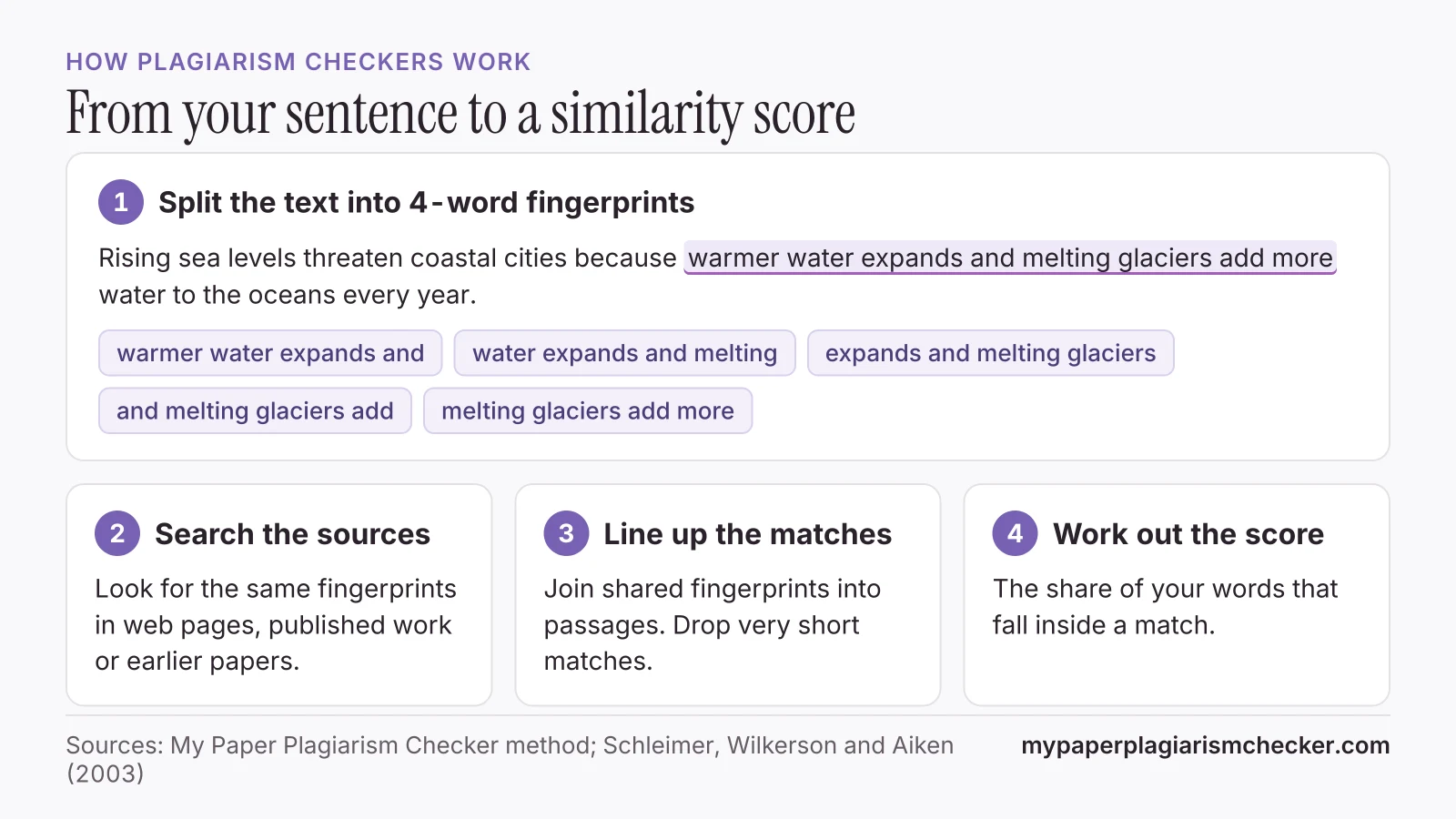
A plagiarism checker splits your paper into fingerprints, searches its sources for the same fingerprints, lines up the matches and turns them into a percentage.
Split the text into fingerprints
The text is cut into short overlapping runs of words. Each run is turned into a number, called a hash, that is fast to compare.
Find possible sources
The checker searches its sources for text that shares those fingerprints: web pages, published work or earlier papers, depending on the checker.
Line up the matches
Shared fingerprints are joined into matching passages. Very short matches are dropped, since they are often common phrases.
Work out the score
The similarity score is the share of your words that fall inside a match. The report lists each source next to the passages it matched.
What is a text fingerprint?
A fingerprint is a short run of words, stored as a number. Two texts that share a long passage share many fingerprints, so the checker can find the overlap without reading every source word by word.
The idea comes from document fingerprinting research. A 2003 paper on the method describes it: “Divide a document into k-grams, where k is a parameter chosen by the user.” Then “hash each k-gram and select some subset of these hashes to be the document's fingerprints.” The same paper adds that a match “must be large enough to imply that the material has been copied and is not simply a common word or idiom”. My Paper Plagiarism Checker uses runs of 4 words.
Source: Schleimer, Wilkerson and Aiken, Winnowing: Local Algorithms for Document Fingerprinting (SIGMOD 2003).
Rising sea levels threaten coastal cities because warmer water expands and melting glaciers add more water to the oceans every year.
4-word fingerprints from the highlighted partWhy plagiarism checkers give different scores
Two checkers can score the same paper differently because they search different sources and use different rules for what counts.
Different sources
Each checker searches its own mix of web pages, published work and earlier papers. A source one checker lacks cannot match. Chatbots work differently. See can ChatGPT check for plagiarism.
Different shortest match
Each checker drops matches below a set length. Turnitin's newer report defaults to 8 words. My Paper Plagiarism Checker drops matches under 10 words.
Different quote rules
Some checkers count quotes and the reference list, some leave them out, and some let an instructor choose.
Turnitin's guide on its filters says of small matches: “By default, the threshold is 8 words, meaning that only matches 8 words or longer appear in the Similarity Report.” Source: How exclusion filters refine the Similarity Report. For what the number means once you have it, see reading your similarity score.
Can plagiarism checkers detect paraphrasing?
They catch light edits, where most of the wording stays the same, and often miss full rewording.
Fingerprint matching needs runs of identical words. Change one word and the runs on either side still match. Reword every sentence and there is little left to match. A 2020 test of 15 text-matching systems found that “software performs worse on synonym replacement and manual paraphrase plagiarism”, and that “For paraphrased texts, none of the systems was able to provide satisfactory results.” Translated text was rarely found: “The vast majority of the systems did not find text translated by either of them.”
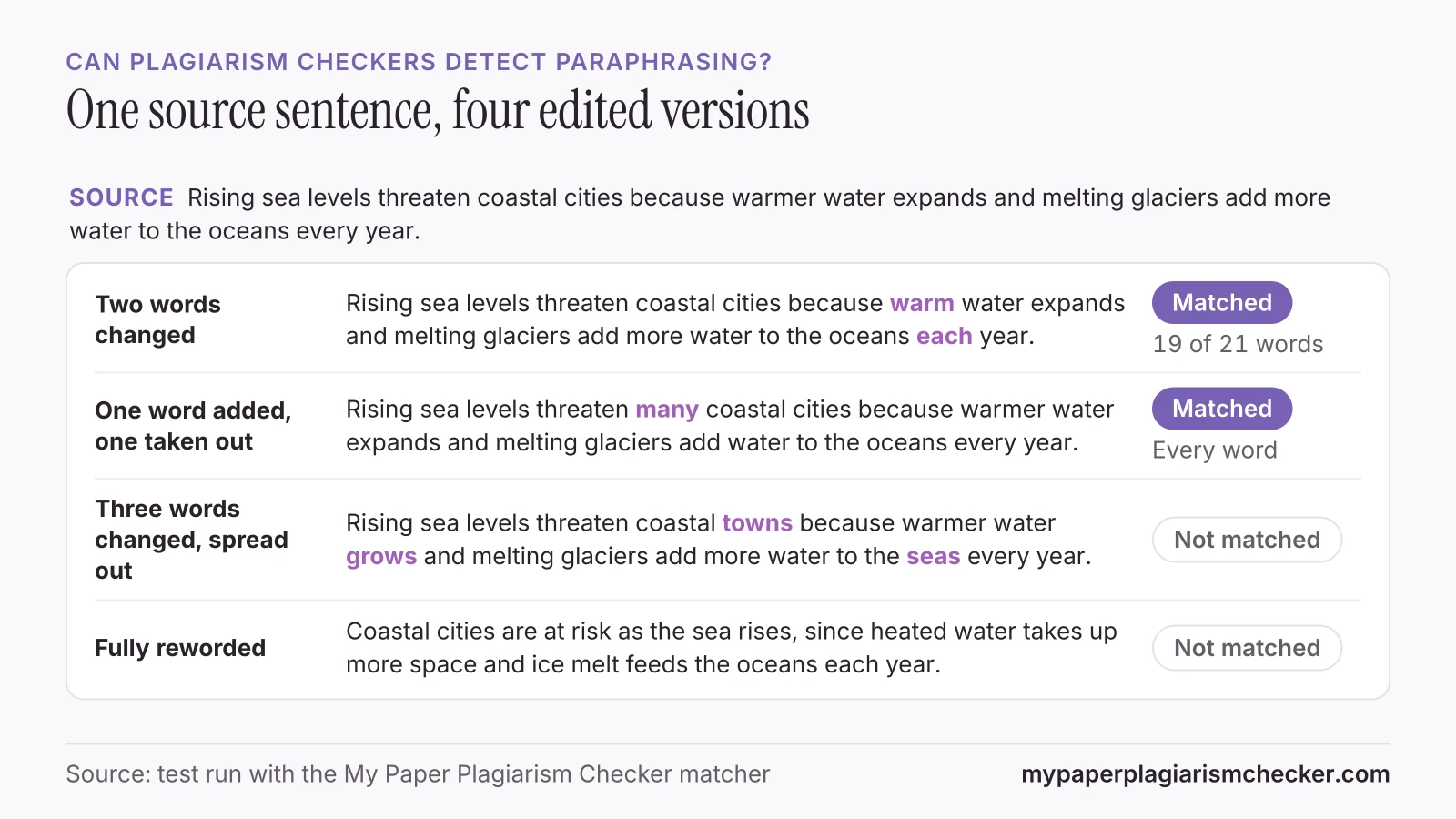
Here is one source sentence checked against four versions with My Paper Plagiarism Checker's matcher. Source sentence: “Rising sea levels threaten coastal cities because warmer water expands and melting glaciers add more water to the oceans every year.”
| Version | Student sentence | Result |
|---|---|---|
| Two words changed | Rising sea levels threaten coastal cities because warm water expands and melting glaciers add more water to the oceans each year. | Matched 19 of 21 words |
| One word added, one taken out | Rising sea levels threaten many coastal cities because warmer water expands and melting glaciers add water to the oceans every year. | Matched every word |
| Three words changed, spread out | Rising sea levels threaten coastal towns because warmer water grows and melting glaciers add more water to the seas every year. | Not matched |
| Fully reworded | Coastal cities are at risk as the sea rises, since heated water takes up more space and ice melt feeds the oceans each year. | Not matched |
Both unmatched versions still take the idea from the source, so they still need a citation. Source for the test quotes: Foltýnek et al., Testing of support tools for plagiarism detection (International Journal of Educational Technology in Higher Education, 2020).
How does Turnitin work?
Turnitin compares a submission with its database and highlights the text that matches. Your instructor sees a Similarity Report, and you see it only if your instructor allows it.
“Our database includes current and archived content from the internet, thousands of periodicals, journals, and publications, as well as a repository of works other students have submitted to Turnitin.”
“Turnitin does not check for plagiarism in writing. We do check all submissions against our database.”
Your instructor chooses filters that can leave quotes, the bibliography and small matches out of the report. Turnitin's student guide also describes a check for copying between classmates: Turnitin can run “a final similarity check against all submitted assignments after the due date.”
Turnitin's AI writing check is separate from the similarity score. Its guide says the AI percentage “is different from and independent of the similarity score” (Using the AI Writing Report). My Paper Plagiarism Checker is not affiliated with Turnitin and cannot search Turnitin's database.
How we check papers on My Paper Plagiarism Checker
My Paper Plagiarism Checker cuts your paper into 4-word fingerprints, looks for them in the sources below, and counts a match only when it is long enough to show copying.
This is the method our plagiarism checker for students runs on every paper you paste or upload.
Where we look for matches
We look up your paper's fingerprints in our own indexes, and search the other sources with the most distinctive sentences in your paper.
Wikipedia
Matched on our own server against our copy of English Wikipedia, about 7.1 million articles. Nothing is sent to Wikipedia.
Academic papers
Abstracts of academic papers, found through OpenAlex, an open index of scholarly work. Our server sends OpenAlex up to 10 distinctive sentences from your paper as searches, with nothing that identifies you.
Earlier papers checked on My Paper Plagiarism Checker
A match with another student's paper shows as “Another paper checked on My Paper Plagiarism Checker”, never with a name. With a free account, your own earlier papers are matched too, and only you see those matches.
Web pages
Being added. Until then, a match on a web page outside the sources above will not show.
When a match counts
A shared fingerprint alone is not a match. The words around it have to line up with the source, in the same order.
| Rule | What it means for your paper |
|---|---|
| Fingerprint size: 4 words | Short enough that changing one word leaves the runs around it intact. |
| One exact run of 8 words | A matching passage needs at least 8 words in a row that are the same as the source. |
| Or 3 pieces totaling 14 or more words | Lightly edited text counts when 3 or more matching pieces, in the source's order and at most 3 words apart, add up to 14 words or more. |
| Shortest match: 10 words | The whole matching passage must be at least 10 words long. Anything shorter is left out, so common phrases and set terms do not raise your score. |
Quotes and references
- Quotes with a citation are left out of the score. A citation next to the quote counts, such as (Smith, 2020), (para. 4), [3] or Smith (2020), and so does a quote introduced with “according to”.
- Quotes with no citation are counted. The report flags each one that is 8 words or longer.
- Double quotes, single quotes and indented block quotes are all handled.
- Your reference list is left out when it sits under a heading such as References, Bibliography or Works Cited in the second half of the paper.
- Heavy quoting gets a warning when more than 15% of the paper is inside quotation marks.
How the score is worked out
Your similarity score is the share of the words checked that fall inside a match. Each source gets its own percentage and is listed with the passages it matched, as the sample plagiarism report shows. The report also shows a second score with quotes and the reference list counted, in case your school counts them.
How the AI check works
The AI check reads your paper in overlapping windows, gives a verdict for the whole paper, and highlights the sentences that read as AI-written.
Our own model, trained on school and university writing and on AI-written and AI-rewritten versions of the same kinds of papers, reads your paper in overlapping windows of about 150 words to give the verdict for the whole paper. It then highlights the sentences that read as AI-written. Your AI score is the share of your words inside highlighted sentences.
A score is a signal to review, never proof. A highlighted sentence may still be your own writing. Read each one before you change it. You can run the AI check alone with the AI detector for students.
What My Paper Plagiarism Checker cannot check yet
No checker finds everything. These are the gaps in ours today.
Full rewording
Text reworded sentence by sentence is not caught yet. Matching by meaning is not built.
Web pages
Web pages are being added as a source. Until then, text copied from a web page may not match.
Full text of papers
We match against the abstracts of academic papers. Text copied from the body of a paper may not match.
Citation checking
We spot whether a quote has a citation. We do not check that the citation is correct.
Scanned PDFs
We read the text inside a file. A scanned PDF has none, so upload the Word file or paste the text.
Proof of plagiarism
A match shows shared wording. Whether it is plagiarism is a decision for a person.
FAQs about plagiarism checkers
How accurate are plagiarism checkers?
They are good at finding copied text and weaker at reworded text. A 2020 test of 15 text-matching systems found that they "clearly do not find all plagiarism and at times also identify non-plagiarized material as problematic."
Can a plagiarism checker prove plagiarism?
No. A checker finds matching text. Whether a match is plagiarism depends on whether it is quoted and cited, and that is a decision a person makes.
Does My Paper Plagiarism Checker check against Turnitin's database?
No. Turnitin's database, including its repository of earlier student papers, is Turnitin's own. My Paper Plagiarism Checker searches the sources listed on this page.
Why does My Paper Plagiarism Checker ignore matches under 10 words?
Short matches are usually common phrases and set terms. Leaving them out keeps the report focused on passages you may need to quote, cite or rewrite.
Is my paper stored?
Yes, until you delete it. My Paper Plagiarism Checker keeps the text with its report, and keeps fingerprints of it so later papers checked here can be compared with it. Those matches never show your name. Deleting the report removes its text and fingerprints. Your paper is not sent to your school or to Turnitin.
Can I upload a file?
Yes. Upload a PDF, Word (.docx) or text file up to 20 MB, or paste the text. We pull the text out of the file and check it.
Sources
- Turnitin Guides: Understanding the similarity score for students
- Turnitin Guides: Understanding the similarity score
- Turnitin Guides: How exclusion filters refine the Similarity Report
- Turnitin Guides: Using the AI Writing Report
- Schleimer, Wilkerson and Aiken (2003): Winnowing: Local Algorithms for Document Fingerprinting
- Foltýnek et al. (2020): Testing of support tools for plagiarism detection
- My Paper Plagiarism Checker method: the matching rules above are the settings our checker runs with today.
Check your paper before you hand it in
Free up to 3,000 words. No card needed.