
Why is my writing flagged as AI?
Why your own essay gets flagged for AI
Your writing can be flagged as AI because detectors judge how predictable the wording is. They do not know who wrote it. Formulaic structure, plain or limited vocabulary, short texts and rewrites from grammar or translation tools can all make human writing score as AI. This guide explains each cause, what em dashes really show, and why writing worse on purpose does not help.
How an AI detector decides
An AI detector scores how closely your wording follows the patterns it learned from AI-written text.
AI tools write by picking a likely next word, again and again. Detectors are trained on large sets of human and AI writing to spot the difference. For the models Turnitin covers, see can Turnitin detect ChatGPT. Turnitin explains the method in its FAQ:
“Human writing, on the other hand, tends to be inconsistent and idiosyncratic, resulting in a low probability of picking the next word the human will use in the sequence.”
“Our model is not explicitly programmed to evaluate specific signals such as ‘burstiness,’ ‘perplexity,’ or other individual metrics sometimes referenced in public discussions. Instead, it learns statistical patterns from our training data.”
GPTZero says it moved to a deep-learning model in autumn 2023 and “no longer uses perplexity and burstiness” (GPTZero Support). Because these models learn from examples, a person can write a sentence that looks like the AI text they were trained on. GPTZero puts it plainly: “There are always edge cases, both where AI is classified as human and where human is classified as AI.”
Why your own writing can be flagged as AI
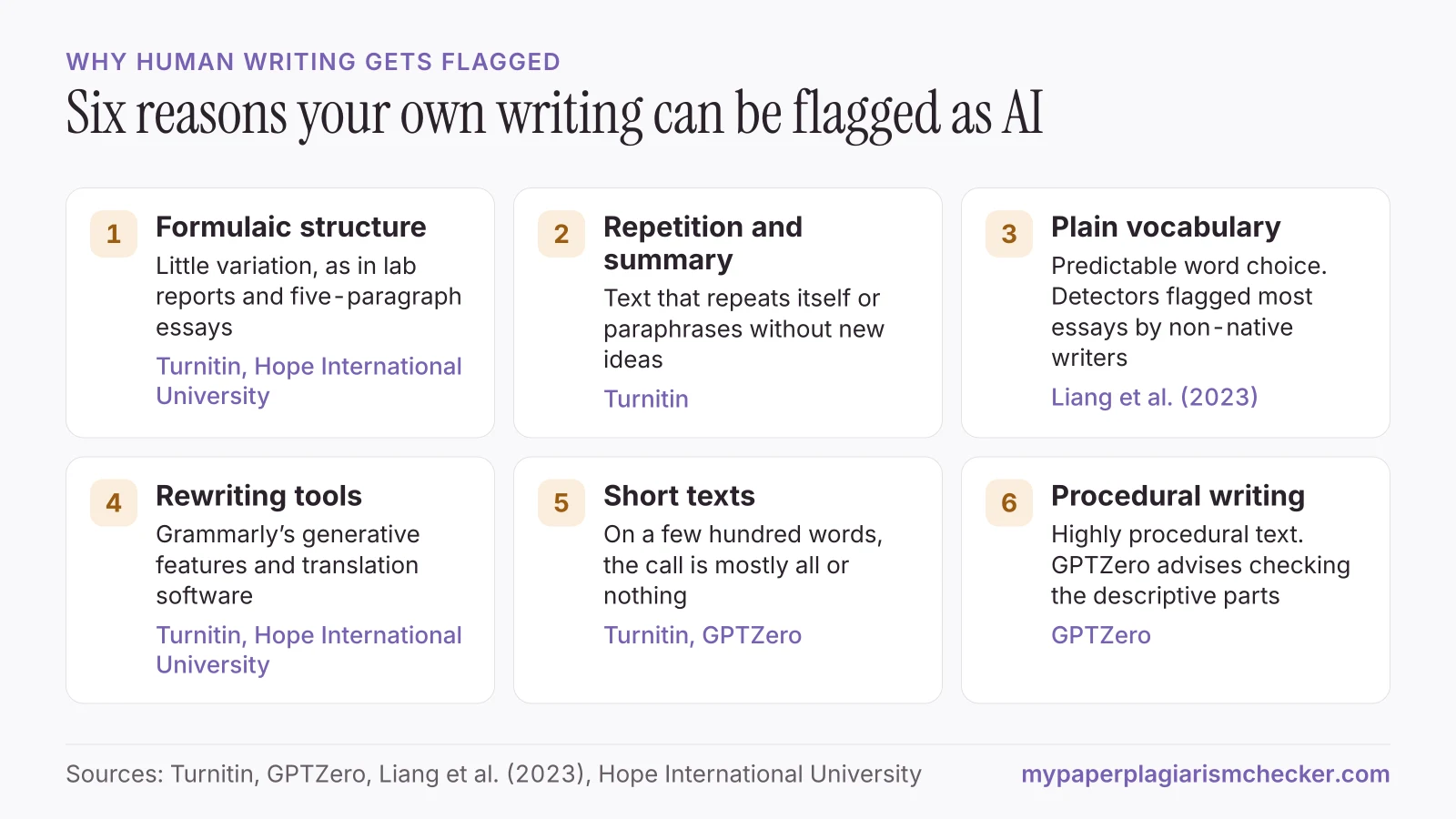
Turnitin, GPTZero, researchers and teaching staff name these causes: formulaic structure, repetition, plain vocabulary, editing tools, short texts and procedural writing.
Formulaic structure
Turnitin says false positives can include “content without a lot of structural variation”. A university faculty guide names lab reports, case studies and five-paragraph essays.
Repetition and summary
Turnitin lists “text that literally repeats itself, or text that has been paraphrased without developing new ideas.”
Plain or limited vocabulary
A 2023 Stanford study found detectors flagged most essays by non-native English writers. More on this below.
Rewriting and translation tools
Turnitin says text from Grammarly's generative features “will likely be flagged”. The faculty guide also names translation software.
Short texts
Turnitin says that on a few hundred words its prediction is mostly “all or nothing”. GPTZero says accuracy rises with more text.
Procedural writing
GPTZero says it can flag “highly procedural text” and advises using it “on the more descriptive portions of a text.”
Position in the paper matters too. In 2023, Turnitin reported “a higher incidence of false positives in the first few or last few sentences of a document”, often the introduction and conclusion, and changed how it scores them (Turnitin blog). The faculty guide quoted above is from Hope International University's library (AI Talks: When a Student Denies Use).
If you edited with Grammarly, see checking for AI after Grammarly. Personal statements are short and follow set patterns, so see the AI detector for personal statements for those.
Can non-AI writing be flagged as AI?
Yes. Turnitin and GPTZero both say human writing is sometimes flagged, and research found non-native English writers flagged far more often.
| Finding | What the source says | Source |
|---|---|---|
| Turnitin, whole documents | False positive rate under 1% for documents with over 20% of AI writing | Turnitin FAQs |
| Turnitin, single sentences (2023) | Our sentence-level false positive rate is ~4%. | Turnitin blog |
| 7 detectors, 91 TOEFL essays by non-native writers (2023) | they misclassified over half of the TOEFL essays as “AI-generated” (average false positive rate: 61.22%). | Liang et al. |
| Same essays, any one detector | 89 of the 91 TOEFL essays (97.80%) are flagged as AI-generated by at least one detector. | Liang et al. |
The essays all seven detectors flagged had lower perplexity, meaning more predictable word choice. The Stanford authors warn: “Practitioners should exercise caution when using low perplexity as an indicator of AI-generated text, as this approach might inadvertently perpetuate systematic biases against non-native authors.” The study tested detectors available in 2023. Turnitin says it built its training data with “second-language learners” in mind.
If English is your second language, see the AI detector for ESL students.
Are em dashes a sign of AI writing?
No. The em dash is a normal punctuation mark that writers used long before AI. Turnitin says its model learns patterns from data and is not programmed to check individual signals.
AI chat tools do use the long dash often. NPR reported in November 2025 that the em dash “is common in AI-generated text”, and that some writers now avoid it while others push back. The same report points to Emily Dickinson, whose poems make heavy use of long dashes (NPR). A reader may notice the dash. That alone does not show who wrote the sentence.
Words people call AI words
The same goes for vocabulary. The University of Calgary's writing centre lists phrases common in AI text, such as “Stands as a…”, “It's important to…” and “Highlighting/emphasizing…”, and notes that many people use them without AI (Why Does My Writing Sound Like AI?).
A study of 14 million PubMed abstracts found that words such as “delves”, “showcasing” and “underscores” became much more common after ChatGPT was released (Kobak et al.). That is a trend across millions of papers. It does not show that one essay using “delves” was written by AI. If a word or a dash is the right choice for your sentence, keep it.
Does writing worse on purpose stop AI flags?
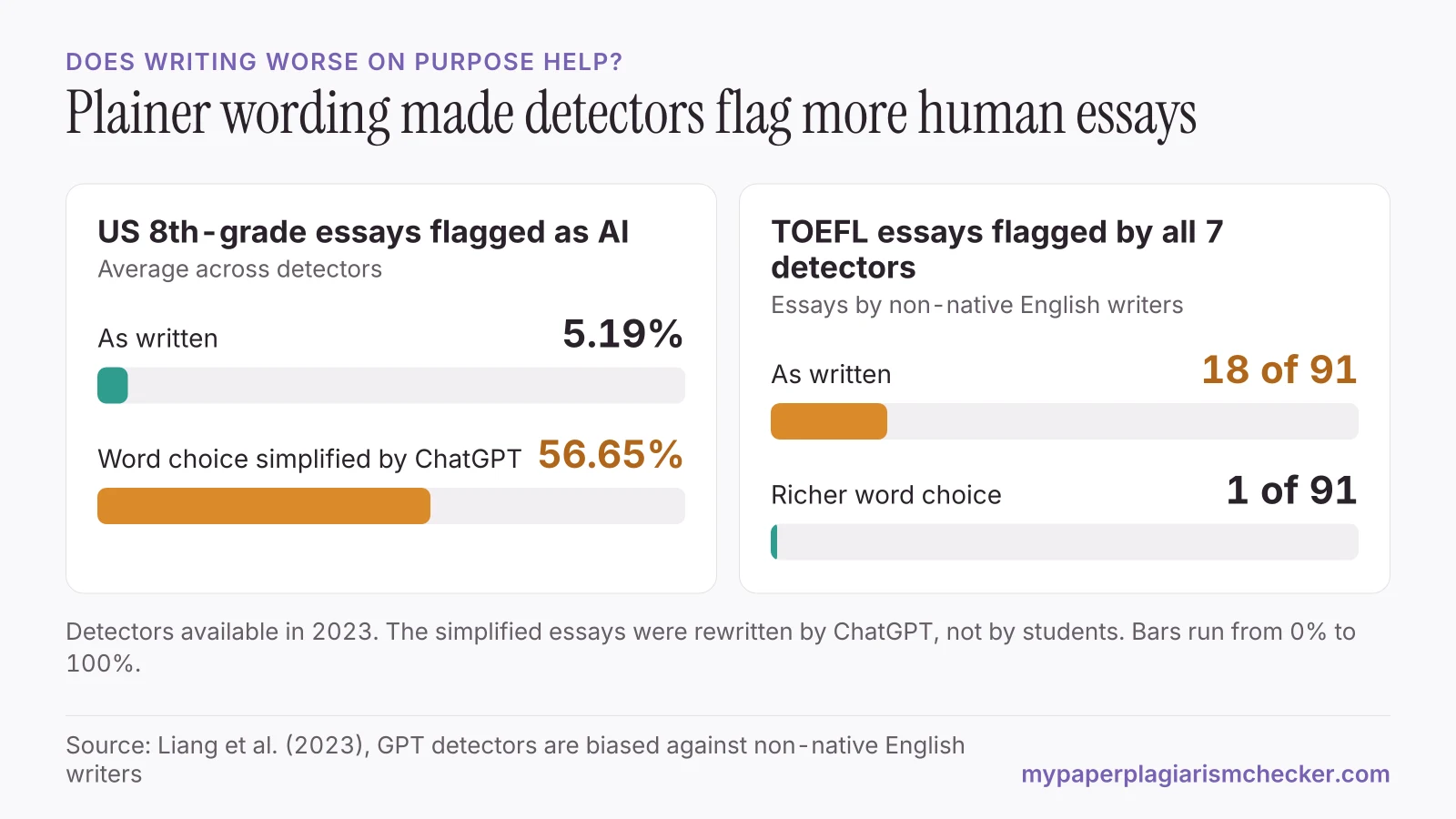
No. In the 2023 Stanford study, simpler word choice made human essays more likely to be flagged as AI.
The researchers took essays by US 8th-grade students and asked ChatGPT to “Simplify word choices as if written by a non-native speaker.” The share flagged as AI rose “from an average of 5.19% across detectors to 56.65%”. In the other direction, richer word choice in the TOEFL essays cut the number flagged by all seven detectors from 18 of 91 to 1 of 91 (Liang et al.).
The simplified versions were rewritten by ChatGPT, so this was not a test of students writing badly by hand. It does show that plainer, more predictable wording pushed detectors toward “AI”. Writing below your level also costs marks.
“I have such anxiety about being wrongfully flagged for AI that I'm purposely writing worse than I usually do.”
“I've had to stop using em dashes despite loving them because apparently it's a sign of AI now”
What helps instead
Keep your drafts
Write in Google Docs or Word with version history on, and save your notes and sources. If a flag turns into a question, you can show how the work grew.
Write in your own voice
The University of Calgary's tips: “Switch up your syntax and sentence lengths.” “Avoid inflating the prose with buzzwords.” “Use words and phrasings that you personally like.”
Say which tools you used
Check your course rules first. Then tell your teacher if a grammar, translation or paraphrasing tool changed your text.
Check before you submit
Run an AI check, read each highlighted sentence, and keep the ones that are yours.
See which sentences read as AI before you submit
The My Paper Plagiarism Checker AI check highlights each sentence that reads as AI-written, so you can review it while you can still edit.
Our own model reads your paper in overlapping windows of about 150 words and highlights each sentence that reads as AI-written. Your AI score is the share of your words in those sentences, as the sample report shows. A highlighted sentence may still be your own writing. Our result can differ from your school's tool, because each detector uses a different model. See how we compare in Turnitin alternative for students.
Your paper is not sent to your school or to Turnitin. My Paper Plagiarism Checker keeps the text with its report until you delete the report. Start with the AI detector for students. If you have already been accused, read what to do if you are falsely accused of using AI.
FAQs about writing flagged as AI
Why does my natural writing sound like AI?
AI tools learned from human writing, so they repeat common human habits: tidy structure, set phrases and formal transitions. The University of Calgary's writing centre puts it this way: "AI sometimes sounds like us, not the other way around." Formal, well-organised writing can share those patterns without any AI use.
Why is my writing being flagged as AI when I did not use AI?
Detectors judge patterns in the wording. They cannot see who typed it. Formulaic structure, repetition, plain vocabulary, short texts and text rewritten by a grammar, paraphrasing or translation tool can all score as AI.
Are em dashes a dead giveaway for AI?
No. AI chat tools use the long dash often, so some readers treat it as a sign, but writers used it long before AI. Turnitin says its model learns patterns from its training data and is not programmed to check single signals.
Will Grammarly get my essay flagged as AI?
Turnitin says that in its tests, grammar and spelling changes from Grammarly were in most cases not flagged. Text from Grammarly's generative features, such as paraphrasing or draft generation, "will likely be flagged as AI-generated".
Why do AI detector results change every time I check?
Each detector uses its own model, so two tools can give the same essay very different scores. Models are also updated. Turnitin says detection can change as its model changes, though a document already submitted only gets a new score if it is submitted again.
What happens if my essay gets flagged for AI?
A flag leads to a review by a person. Turnitin says the final decision on misconduct rests with the instructor. If you have been accused, read our guide on what to do if you are falsely accused of using AI.
Sources
- Turnitin Guides: Turnitin's AI writing detection capabilities FAQs
- Turnitin blog (May 2023): AI writing detection update from Turnitin's Chief Product Officer
- GPTZero Support: What are the limitations of GPTZero's AI classifier?
- GPTZero Support: How do I interpret burstiness or perplexity?
- Liang, Yuksekgonul, Mao, Wu and Zou (2023): GPT detectors are biased against non-native English writers (Patterns)
- Kobak, González-Márquez, Horvát and Lause (2024): Delving into ChatGPT usage in academic writing through excess vocabulary
- Hope International University library: AI Talks: When a Student Denies Use
- University of Calgary Student Success Centre: Why Does My Writing Sound Like AI?
- NPR (November 2025): Inside the unofficial movement to save the em dash from A.I.
Pages read 13 November 2026
Check your paper before you hand it in
Free up to 3,000 words. No card needed.