
Falsely accused of using AI?
What to do if a professor accuses you of using AI
If you are accused of using AI on work you wrote yourself, read the message calmly, ask what the concern is based on, gather your drafts, and answer through your school's process. Turnitin says its AI score should not be the only basis for action against a student, and GPTZero says its results should not be used to punish students. This guide walks through each step.
What to do if you are falsely accused of using AI
Ask for the evidence, show how you wrote the work, and answer in writing at each stage of your school's procedure.
Read the message before you reply
Note who sent it, which assignment it is about and any deadline. A first email may say little. Students' Union UCL warns that it “will probably not tell you what kind of academic misconduct has been suspected.”
Find your school's rules
Read the AI policy in your syllabus or assignment brief, and your school's academic integrity procedure. They say what counts as misuse, who decides and how you can respond.
Ask what the concern is based on
Ask politely which passages are in question and what the evidence is: a detector score, a change in style, or sources that do not check out. Students cannot see Turnitin's AI report, but its guide says instructors “can download and share the AI report with students.”
Gather your writing record
Save your drafts, version history from Google Docs or Word, notes, outline and the sources you read before anything changes. Ohio State tells notified students to “review relevant information (e.g., personal files, course documents on Carmen)”.
Be ready to explain your work
You may be asked to talk through your argument, sources and choices. Turnitin's suggested questions for teachers start with “Explain your process for completing this assignment.” At UCL, a suspected GenAI case can lead to an investigatory viva.
List the tools you used
Say which tools touched the text: spell check, Grammarly, a translator or a citation tool. Turnitin says grammar fixes were usually not flagged in its tests, but text from Grammarly's generative features “will likely be flagged”.
Answer in writing and keep copies
Write a short, factual reply. Say what you did, attach what you have and keep every email. Students' Union UCL notes that you “will often be given the opportunity to write a statement.”
Get support and know the appeal route
Your students' union, student advocate or ombuds office can explain the process. Every procedure we read has an appeal. UCL asks for notice of appeal within ten working days of the formal outcome.
If you are not sure why your work was flagged in the first place, see why your writing can be flagged as AI. If you used Grammarly, read checking for AI after Grammarly.
What AI detectors say about their own limits
Turnitin and GPTZero both say their AI results can be wrong and should not decide a case on their own.
“Our AI writing detection model may not always be accurate (it may misidentify human-written, AI-generated, and AI-paraphrased text), so it should not be used as the sole basis for adverse actions against a student.”
“These results should not be used to punish students. While we build more robust models for GPTZero, we recommend that educators take these results as one of many pieces in a holistic assessment of student work.”
What Turnitin says about false positives
A false positive is human writing marked as AI-written. Turnitin publishes these figures for its own detector.
| What is measured | What Turnitin says | Source |
|---|---|---|
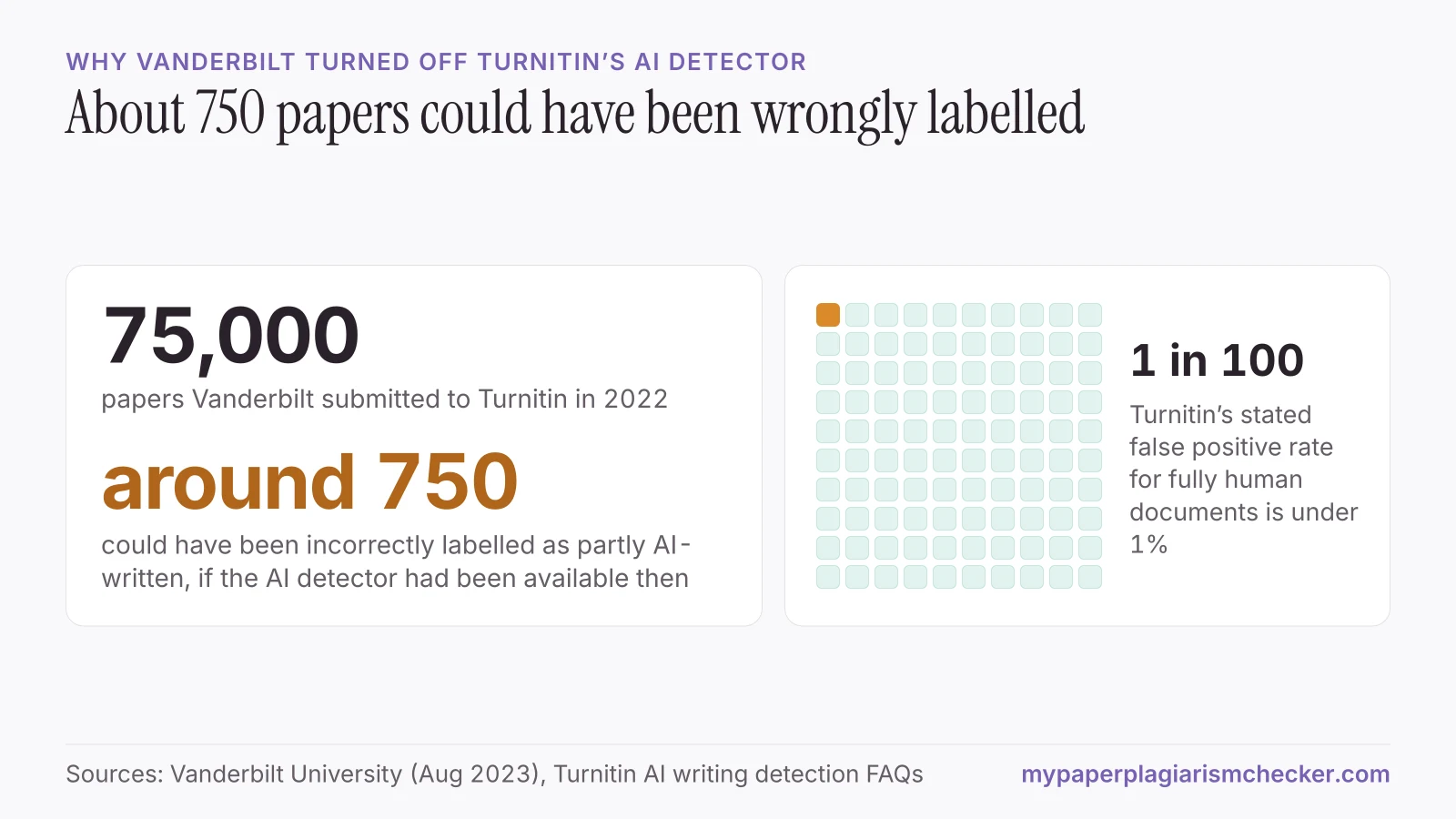
| Whole documents | under 1% for documents with over 20% of AI writing. In other words, we might flag a human-written document as AI-written for one out of every 100 fully-human written documents. | AI writing detection FAQs |
| Single highlighted sentences (2023) | Our sentence-level false positive rate is ~4%. | Update from Turnitin's Chief Product Officer |
| Scores from 1% to 19% | Shown as an asterisk with no percentage, To avoid potential incidence of false positives. | Using the AI Writing Report |
| Who decides | The final decision on whether any misconduct has occurred rests with the reviewer/instructor. | What should I do if the AI writing percentage is high? |
Each tool's number means something different, so ask which tool produced the score you were shown. GPTZero says a score of “75% AI” is its model's confidence about the whole document: “It does not mean that 75% of the sentences are AI-written.” Source: How do I interpret a GPTZero result? For how GPTZero performs, see is GPTZero accurate.
Universities that turned off AI detection
Some universities have stopped using Turnitin's AI detector. Vanderbilt University disabled it in 2023 and worked out the risk on its own numbers: “Vanderbilt submitted 75,000 papers to Turnitin in 2022. If this AI detection tool was available then, around 750 student papers could have been incorrectly labeled as having some of it written by AI.” (Vanderbilt Brightspace)
The University of Waterloo switched it off from September 2025. Its internal testing found that “in more than one instance the product flagged human written text as 100% generated by AI, which is concerning.” (University of Waterloo)
What happens after an AI accusation at university
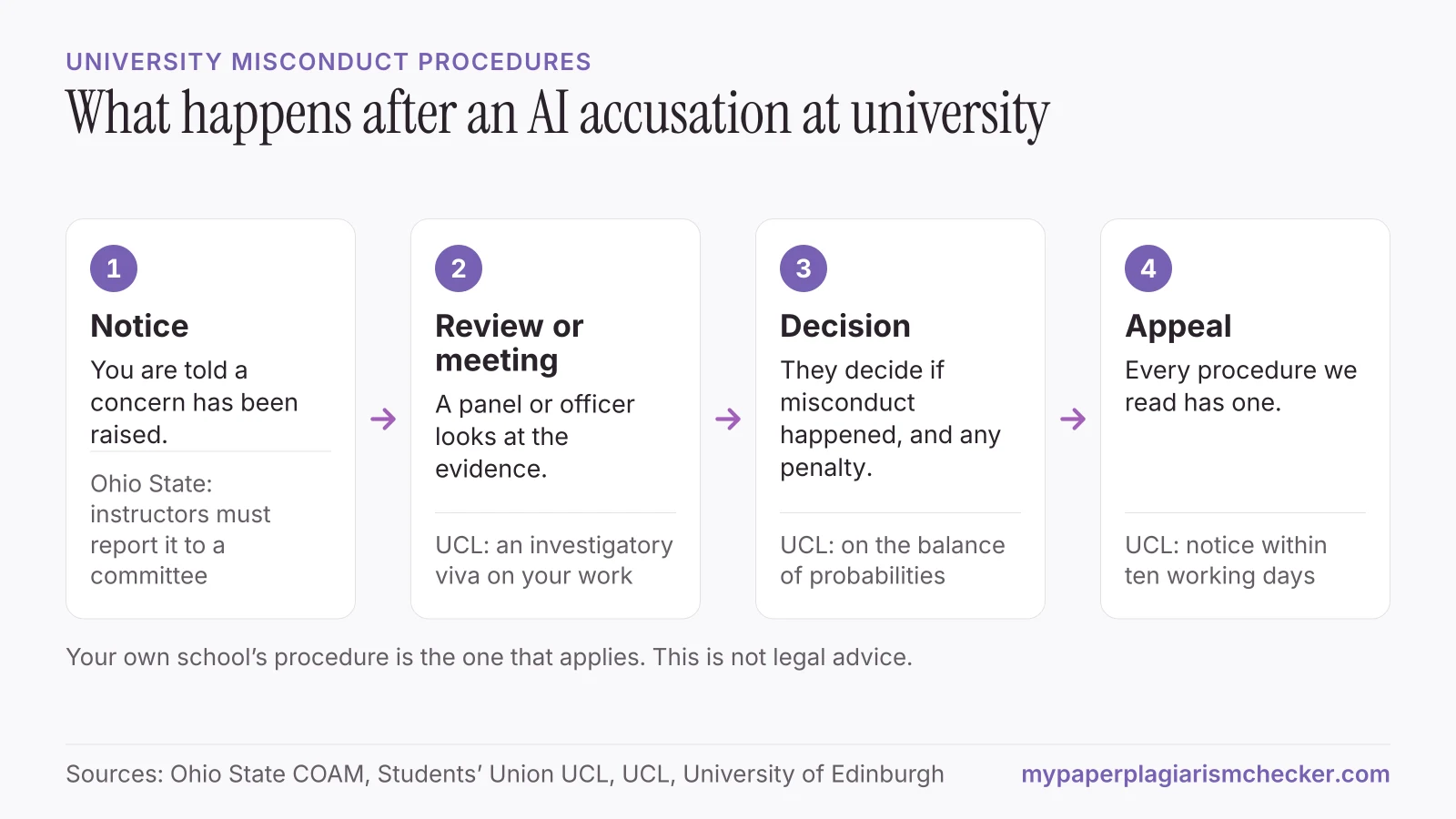
In the procedures below, a case starts with a notice, moves to a review or meeting, and ends with a decision you can appeal.
| University | How a case runs | Source |
|---|---|---|
| Ohio State University (US) | By university rule, an instructor must report any suspected instance of academic misconduct to the Committee on Academic Misconduct (COAM). A review panel of the committee will investigate the charges, decide whether or not a violation has occurred, and if the panel finds there has been an offense, determine an appropriate penalty. | COAM, Students |
| UCL (UK) | If there is a suspicion of Contract Cheating, Collusion or unsanctioned or unacknowledged use of Generative Artificial Intelligence tools (GenAI), you might be invited to an investigatory viva. This is an initial step to test your understanding of the work and explore what evidence is available to show you authored the work. | Students' Union UCL |
| University of Edinburgh (UK) | Suspected cases are investigated by one of the University's network of School and College Academic Misconduct Officers (SAMOS/CAMOS) who are responsible for the investigation at School or College level, and for determining appropriate penalties. | Academic misconduct procedure |
At Ohio State, “any student charged has the right to a hearing before a panel of faculty and student representatives.” At UCL, a panel decides “on the balance of probabilities”, and you can bring a ‘friend’ such as a Students' Union advisor (About Academic Misconduct). Edinburgh students have “the right to appeal decisions made by a Board of Examiners”.
High schools and other colleges have their own rules. Your school's procedure is the one that applies. This page describes typical university processes and does not give legal advice.
What to bring to a meeting or hearing
Drafts and version history
Earlier versions show the paper growing over days or weeks.
Notes and outline
They show how your argument took shape before the final draft.
Your sources
Be ready to say where each idea came from and find the page.
Earlier work
Vanderbilt advises teachers to compare a paper with the student's other work. Past assignments show your usual style.
A list of tools
Grammar, translation and citation tools, and what each one changed.
A short timeline
When you started, when you wrote each part and when you submitted.
No single file proves who wrote a paper. Each one adds detail about how you wrote it.
What students say about AI accusations
Students describe zeros given with no evidence shown, and tell each other to ask for the evidence and use their draft history.
“Just got accused of using AI. No evidence provided from my teacher, just a random accusation and a zero.”
“I'm being falsely accused of AI usage and I'm about to fail my course because of it”
“you can ask them to explain exactly which sections they think are ai generated and what evidence they're using beyond turnitin scores.”
“If your prof doesn't clear you after seeing your draft history, go to the department chair.”
These come from about 1,800 student threads we collected from Reddit, Quora, The Student Room and other forums in November 2026. Threads about AI accusations and proving authorship were among the largest groups.
Can a My Paper Plagiarism Checker report help?
It can be supporting material next to your drafts. No AI detector result, including ours, proves how a text was written.
Our AI check highlights the sentences that read as AI-written and gives an AI score: the share of your words in those sentences, as the sample report shows. Each detector uses a different model. A low score from us does not cancel a high score from another tool, and a high score from us does not prove AI use.
If you share a report, share it as one more piece of information, with your version history and notes. Your paper is not sent to your school or to Turnitin. My Paper Plagiarism Checker keeps the text with its report until you delete the report. A report from a check without an account opens for 5 minutes in the browser that ran it, so download the PDF or use a free account to keep it.
Run the check on its own with the AI detector for students. If English is not your first language, see the AI detector for ESL students. For applications, see the AI detector for personal statements. To see how our checker differs from your school's, read Turnitin alternative for students. My Paper Plagiarism Checker is not affiliated with Turnitin.
FAQs about AI accusations
What to do if falsely accused of using AI?
Read the message, find your school's AI policy, and ask what the concern is based on. Then gather your drafts and version history, be ready to explain how you wrote the work, and reply in writing through your school's procedure. Keep copies of everything.
Can professors actually prove you used AI?
An AI detector score cannot prove it on its own. Turnitin says its percentage "should not be used as the sole basis for action", and GPTZero says its results "should not be used to punish students". In the university procedures we read, a person or panel looks at the wider case before deciding.
How can I prove I didn't use AI?
There is no single file that proves it. Version history, dated drafts, notes, the sources you read and a clear account of how you wrote the paper together show your process. Being able to talk through your argument and sources in a meeting also counts.
Can a university accuse you of using AI?
Yes. A university can open a misconduct case if it suspects unauthorised AI use, and each university has its own procedure. At UCL, for example, a student can be invited to an investigatory viva when unacknowledged use of GenAI tools is suspected.
What happens if my essay gets flagged for AI?
A flag leads to a review by a person. Turnitin says the final decision "rests with the reviewer/instructor". Depending on your school, that can mean a talk with your teacher, a formal meeting or a panel hearing, followed by a decision you can appeal.
Is it possible to be falsely accused of using AI?
Yes. Turnitin says its false positive rate is not zero, and the University of Waterloo found its tool "flagged human written text as 100% generated by AI" in more than one case. A 2023 Stanford study found non-native English writers were flagged far more often than native writers.
Sources
- Turnitin Guides: Using the AI Writing Report
- Turnitin Guides: Turnitin's AI writing detection capabilities FAQs
- Turnitin Guides: What should I do if the AI writing percentage is high?
- Turnitin Guides: What questions do I ask my student if AI is detected?
- Turnitin blog (May 2023): AI writing detection update from Turnitin's Chief Product Officer
- GPTZero Support: What are the limitations of GPTZero's AI classifier?
- GPTZero Support: How do I interpret a GPTZero result?
- Ohio State University: Committee on Academic Misconduct, Students
- UCL: About Academic Misconduct
- Students' Union UCL: Academic Misconduct: What happens if I receive an allegation?
- University of Edinburgh: Academic misconduct procedure
- Vanderbilt University: Guidance on AI Detection and Why We're Disabling Turnitin's AI Detector
- University of Waterloo: Discontinuing use of AI detection functionality in Turnitin
Pages read 13 November 2026
Check your next paper before you hand it in
Free up to 3,000 words. No card needed.