
Is GPTZero accurate?
GPTZero accuracy and false positives
GPTZero is good at catching unedited AI text, and it can still flag human writing as AI. GPTZero reports 99% accuracy and a false positive rate of 1% or lower in its own tests. Independent studies found more false positives on some kinds of writing, and GPTZero says a score should not be the only proof used to punish a student.
How accurate is GPTZero?
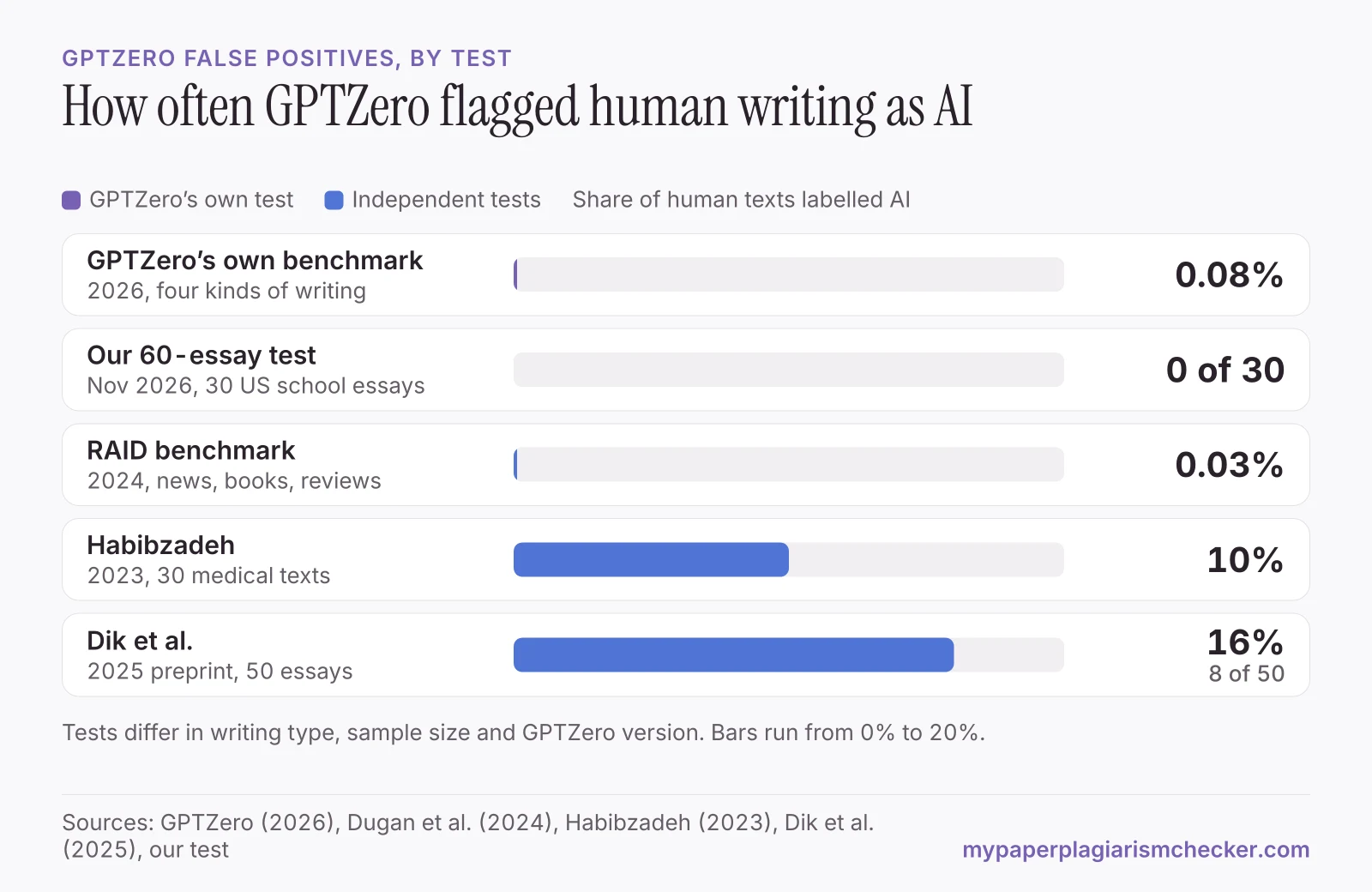
GPTZero catches most unedited AI text. How often it flags human writing depends on the test: under 1% in large benchmarks and in our own small test, and 10% to 16% in two small studies of essays and medical writing.
Here is what each test found, newest first. Read the dates: GPTZero says it updates its model every month, so a 2023 test describes a 2023 version.
| Test | What was tested | What it found |
|---|---|---|
| Our test (November 2026) | 30 US school essays and 30 AI essays | 0 of 30 human essays flagged. 29 of 30 AI essays caught. |
| GPTZero's own benchmark (2026) | Academic paper reviews, creative writing, essays and product reviews | 99.76% accuracy, 0.08% false positives |
| Dik et al. (2025, preprint) | 50 human and 28 ChatGPT essays, 40 to 800 words | 8 of 50 human essays flagged (16%). All 28 AI essays caught. |
| RAID benchmark (2024) | Over 6 million AI texts in 8 domains such as news, book summaries and reviews | 0.03% false positives at a 0.25 cut-off. AI caught ranged from 98.8% to 4.8%, depending on the AI model and its settings. |
| Weber-Wulff et al. (2023) | 54 test documents, 14 detectors, GPTZero tested in March 2023 | Half of GPTZero's AI flags were false accusations |
| Habibzadeh (2023) | 20 ChatGPT texts and 30 published medical texts | 10% false positives. 35% of AI texts missed. |
| Liang et al. (2023) | 91 TOEFL essays by non-native writers, 7 detectors including GPTZero | 61.22% average false positive rate across the 7 detectors |
What GPTZero says about its accuracy
GPTZero says it is 99% accurate and keeps its false positive rate at 1% or less.
“We keep GPTZero's false positive rate at no more than 1% when evaluating AI versus human text.”
“We don't recommend using an AI detection result as the only proof for academic punishment or discipline.”
GPTZero's 2026 benchmark reports 99.76% accuracy and a 0.08% false positive rate for its model version 4.3b, averaged across four kinds of writing. It says the benchmark is updated every quarter and that raw predictions are available to researchers. Source: GPTZero AI Detection Benchmarking.
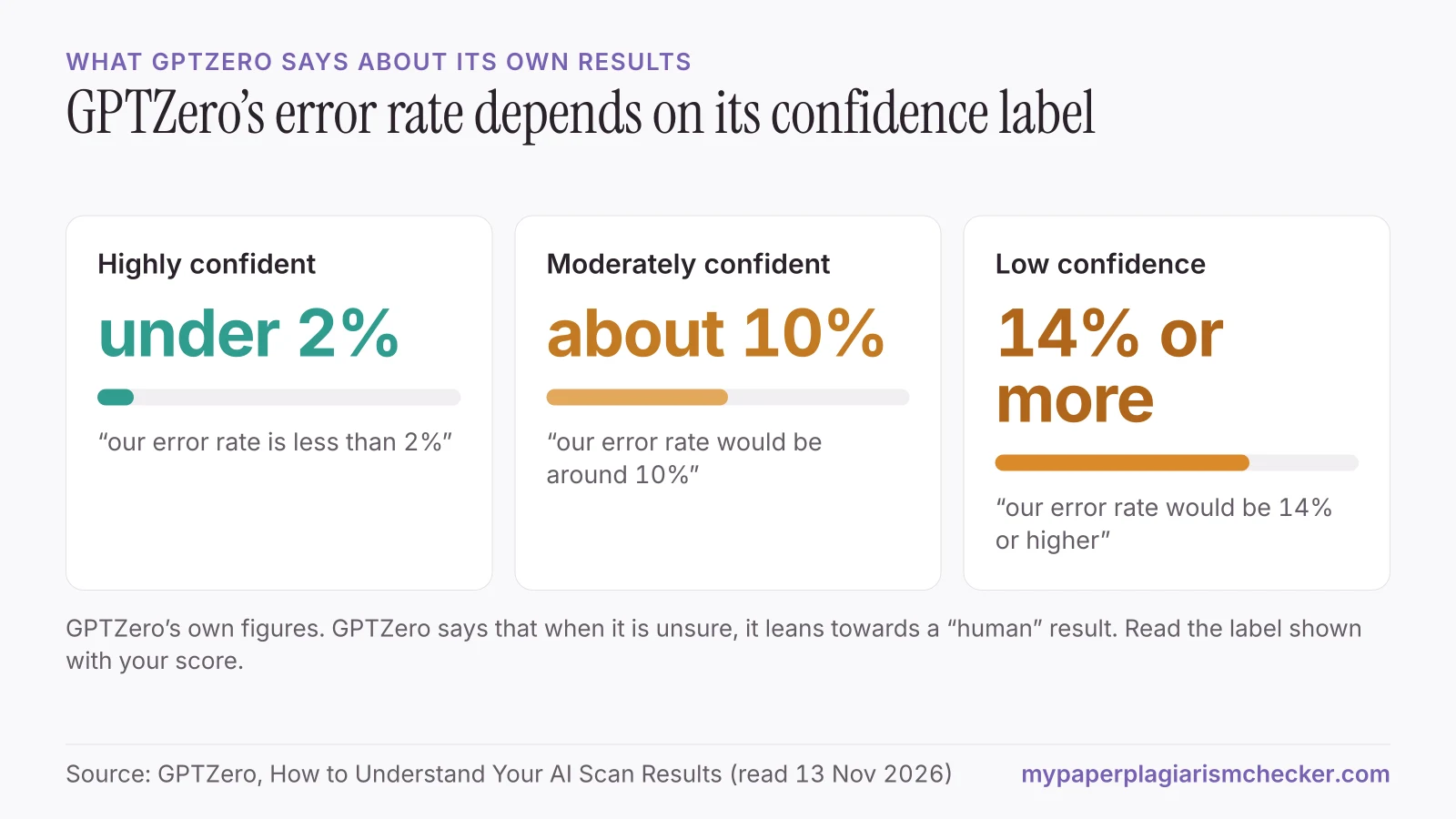
Each GPTZero result comes with a confidence level. GPTZero gives these error rates for each one:
- Highly confident: “our error rate is less than 2%”
- Moderately confident: “our error rate would be around 10%”
- Low confidence: “our error rate would be 14% or higher”
GPTZero also says that when it is unsure, it leans towards a “human” result “to avoid the case where a human is falsely accused of AI.” These are GPTZero's own figures, from tests GPTZero runs itself.
What independent tests found
The largest benchmark found very few false positives. Smaller tests of student essays, academic writing and non-native writing found more.
The RAID benchmark (2024)
RAID tested 12 detectors on over 6 million AI-written texts. GPTZero was queried in January 2024. At a 0.25 score cut-off, GPTZero flagged 0.03% of human texts, the lowest of the four paid detectors tested. How much AI text it caught depended on the AI model and its settings, from 98.8% down to 4.8%. The authors also found that “All detectors were sensitive to homoglyph attacks except for GPTZero.” RAID used news, book summaries, recipes, poems, reviews and other web text, with no student essays. Source: Dugan et al., RAID: A Shared Benchmark for Robust Evaluation of Machine-Generated Text Detectors.
A test of 14 detectors (2023)
“For GPT Zero, half of the positive classifications would be false accusations, which makes this tool unsuitable for the academic environment.”
Nine researchers prepared 54 test documents and ran them through 14 detectors between March and May 2023. False accusations were counted on human-written and machine-translated documents. The same study found GPTZero had the lowest share of missed AI text, at 8%. Its overall conclusion covered every tool tested: “the available detection tools are neither accurate nor reliable.”
Non-native English writers (2023)
A Stanford study ran 91 TOEFL essays by non-native English writers through seven detectors, GPTZero among them. The detectors were near-perfect on US 8th-grade essays, but “misclassified over half of the TOEFL essays as ‘AI-generated’ (average false positive rate: 61.22%).” The tests were run in March 2023. Source: Liang et al., GPT detectors are biased against non-native English writers (Patterns, 2023).
GPTZero has since tested its newer model on this question. In October 2026 it reported that GPTZero 4o labelled all 914 essays by English language learners in the PERSUADE 2.0 test set as human-written. Source: GPTZero. If English is not your first language, see the AI detector for ESL students.
Small tests of essays and medical writing
A 2025 preprint tested 50 human essays and 28 ChatGPT essays. GPTZero caught every AI essay, and flagged 8 of the 50 human essays as AI, a 16% false positive rate. Short human essays under 100 words got the highest average AI score. Source: Dik, Erdem and Dik, Assessing GPTZero's Accuracy in Identifying AI vs. Human-Written Essays.
A 2023 study of 50 medical texts found GPTZero had “a low (10%) false-positive” rate and “a high (35%) false-negative rate”, meaning it missed about a third of the AI texts. Source: Habibzadeh, GPTZero Performance in Identifying Artificial Intelligence-Generated Medical Texts (Journal of Korean Medical Science).
What our test of GPTZero found
GPTZero labelled all 30 human essays as human and caught 29 of 30 AI essays: 59 of 60 correct.
We ran 60 essays through GPTZero's web app on 10 November 2026, one scan per essay.
| Essays | Labelled human | Labelled AI |
|---|---|---|
| 30 essays by US school students, grades 6 to 12 | 30 | 0 |
| 30 AI-written essays on the same kind of prompts | 1 | 29 |
Every human essay came back as “highly confident this text is entirely human”. The one AI essay GPTZero missed was the shortest in the set, a 132-word essay from ChatGPT. GPTZero gave it 11% AI, 16% mixed and 73% human, with the label “moderately confident this text is entirely human”.
What we tested
- Human essays: 30 persuasive essays from the PERSUADE 2.0 corpus, written by US students in grades 6 to 12. 190 to 1,041 words.
- AI essays: 30 essays from the DAIGT v2 dataset, written by AI models including Llama 2, Mistral, PaLM, Claude, GPT, Cohere and Falcon. 132 to 644 words.
- Prompts: 15 essay topics, such as car-free cities and the Electoral College.
Limits of our test
- 60 essays is a small sample. One more error would move the result by almost 2 points.
- School essays only. There was no university writing, no writing by non-native speakers, and no human essay edited with a grammar tool.
- Unedited AI text. The AI essays came straight from older models, with no paraphrasing or rewriting.
- Familiar ground for GPTZero. PERSUADE 2.0 is public, and GPTZero says it tests its model on it.
When GPTZero false positives happen
GPTZero is more likely to flag human writing that is short, formal, heavily edited, machine-translated or written in a second language.
Writing in a second language
In a 2023 study, seven detectors including GPTZero flagged over half of 91 TOEFL essays on average. GPTZero says its 2026 model flagged none of 914 essays by English learners.
Short texts
In a 2025 study, human essays under 100 words got the highest average AI score. The only AI essay GPTZero missed in our test was the shortest one.
Formal or formulaic writing
GPTZero says writing that follows a template too closely can resemble AI text, and that this is “especially difficult with formal writing.”
Heavy editing
GPTZero lists “You've over-edited your personal voice out of the piece” as a cause, for example by leaning hard on a grammar checker.
Machine translation
A 2023 study found false positives rose sharply for text written in another language and then machine-translated into English.
AI polishing
Your own writing tidied up by an AI tool can come back as “mixed”. GPTZero treats that as a correct result.
GPTZero also warns that a single highlighted sentence is weak evidence: “If a single sentence is highlighted, you should not interpret that highlight as independent proof of AI use.” Source: Why Does My Writing Get Flagged as AI (When It's Not)?. For the wider question, see why your writing is flagged as AI. If you use Grammarly, see the AI checker after Grammarly.
What students report
“i've heard that gptzero was most accurate. still, when i submit my essay it shows 100% ai, even though I wrote it.”
“I wrote my entire 20 page essay (by myself) and both grammarly and GPTZero think it's AI.”
“GPTzero tells me my work is 100% human while zeroGPT tell me that it's 71% AI.”
“things that were 100% AI one month ago are now 3% AI. Basically with no change to the text”
Different detectors use different models, so the same essay can score very differently. For two other tools, see is ZeroGPT accurate and is Copyleaks accurate.
Is GPTZero as accurate as Turnitin?
No recent independent test has compared the two. The studies that tested both are from 2023, and they disagree.
GPTZero's own November 2023 benchmark gave GPTZero 99% accuracy and Turnitin 95%, with a 2% false positive rate for each. GPTZero says it has no newer figures for Turnitin because Turnitin is closed-source. The 2023 Weber-Wulff study found the opposite on false positives: “The probability of false positives ranged from 0% (Turnitin) to 50% (GPT Zero).”
Both companies say their score should not be used alone. Turnitin's guide says its model “may not always be accurate (it may misidentify human-written, AI-generated, and AI-paraphrased text), so it should not be used as the sole basis for adverse actions against a student.” Turnitin needs at least 300 words of prose. GPTZero accepts texts from 250 characters, about 50 words. Sources: Using the AI Writing Report, GPTZero AI Detection Benchmarking.
A GPTZero score cannot tell you what Turnitin will show your instructor, because the two use different models. To check your paper before it reaches Turnitin, see the Turnitin alternative for students. My Paper Plagiarism Checker is not affiliated with GPTZero or Turnitin.
What to do if GPTZero flags your own writing
Collect your drafts, notes and version history, and ask your instructor to look at how you wrote the paper.
Read what the score means
GPTZero's percentage is its estimate for the whole document. It does not say what share of your sentences came from AI. Check the confidence level shown with it.
Gather your writing history
Save your drafts, notes, outline, sources and the version history in Google Docs or Word.
Ask for a review of your process
GPTZero advises asking your instructor “to review how the document was created.”
Check before you submit
Run your paper through an AI detector before you hand it in, and read each highlighted sentence yourself.
GPTZero says that if you are “facing disciplinary issues as a result of a false positive (including from other tools)”, you can contact its team. If you have already been accused, see what to do if you are falsely accused of using AI. To check your own paper first, use the AI detector for students. It gives one result for the whole paper and highlights the sentences that read as AI-written.
FAQs about GPTZero accuracy
Does GPTZero give false positives?
Yes. GPTZero says it keeps its false positive rate at 1% or less in its own tests. Independent tests found rates from under 1% to 16% on human-written texts. A 2023 study that also counted machine-translated texts and partial flags put it at 50%.
Is GPTZero more accurate than Turnitin?
No independent test of the current versions answers this. GPTZero's own 2023 benchmark scored GPTZero at 99% and Turnitin at 95%, with 2% false positives each. A 2023 university study of 14 tools found 0% false positives for Turnitin and 50% for GPTZero. Both tools have changed since then.
Is ZeroGPT more accurate than GPTZero?
On false positives, the 2024 RAID benchmark favoured GPTZero. At the same score cut-off of 0.25, ZeroGPT flagged 1.71% of human texts and GPTZero 0.03%. RAID used news, books, reviews and other web text, so it says less about student essays.
Why does GPTZero say I used AI when I didn't?
Detectors look for patterns, and human writing can share them. GPTZero names over-edited text, predictable vocabulary and formulaic structure as common causes, and says formal writing is especially hard. Independent tests also found more false positives on short texts and on writing by non-native speakers.
Can GPTZero detect ChatGPT?
Usually, when the text is unedited. In our test it caught 29 of 30 AI essays, and a 2025 study found it caught all 28 of its ChatGPT essays. Reworded AI text is harder: across 14 tools in a 2023 study, accuracy on machine-paraphrased AI text was 26%.
What does a 20% AI score on GPTZero mean?
It is the model's estimate of how likely the whole document is to be AI-written. GPTZero says its percentage does not mean that share of your document contains AI. Look at the label and the confidence level shown with it.
Do colleges use GPTZero?
Some do. GPTZero sells its detector to schools as well as to students. Other schools use Turnitin or no detector at all. Penn State's academic integrity office says its AI integrity committees should not consider AI detector scores as evidence. Your syllabus or school policy says what applies to you.
Sources
- GPTZero: How AI Detection Benchmarking Works at GPTZero
- GPTZero: GPTZero AI Detection Benchmarking: The Industry Standard in Accuracy, Transparency and Fairness
- GPTZero: How to Understand Your AI Scan Results
- GPTZero: Why Does My Writing Get Flagged as AI (When It's Not)?
- GPTZero: GPTZero records 0 false positives on essays by ESL students or students with disabilities
- Dugan et al. (2024): RAID: A Shared Benchmark for Robust Evaluation of Machine-Generated Text Detectors
- Weber-Wulff et al. (2023): Testing of detection tools for AI-generated text
- Liang et al. (2023): GPT detectors are biased against non-native English writers
- Habibzadeh (2023): GPTZero Performance in Identifying Artificial Intelligence-Generated Medical Texts: A Preliminary Study
- Dik, Erdem and Dik (2025, preprint): Assessing GPTZero's Accuracy in Identifying AI vs. Human-Written Essays
- Penn State Office of Academic Integrity: Guidance Around Faculty Use of AI Detectors
- Turnitin Guides: Using the AI Writing Report
- My Paper Plagiarism Checker test: 60 essays from the DAIGT v2 dataset, with human essays from the PERSUADE 2.0 corpus (CC BY 4.0), scanned in GPTZero on 10 November 2026.
Pages read 13 November 2026
Check your paper before you hand it in
Free up to 3,000 words. No card needed.