Is Copyleaks accurate?
Copyleaks AI detection, for students
Copyleaks did well in some independent tests, and it still flags some human writing as AI. It reports over 99% accuracy from its own testing. A 2023 study of 16 detectors put it among the three most accurate. A 2024 study ranked it first and found it flagged 5 of 10 human-written samples. Copyleaks says false positives can happen and its report is one data point.
What Copyleaks says about its accuracy
Copyleaks says its AI detector is over 99% accurate. Its pages give three different false positive rates: 0.03%, 0.2% and 0.30%.
| Figure | What Copyleaks says | Source |
|---|---|---|
| Over 99% accuracy, 0.03% false positives | With over 99% accuracy and an industry-low .03% false positive rate, Copyleaks leads the field in trusted detection. | AI Detector page |
| 99.12% accuracy | The AI Detector has a 99.12% accuracy, the highest of any detector available. | How accurate is the AI Detector? |
| 0.2% false positives | the lowest false-positive rate of any platform, at 0.2% | AI Best Practices Guide |
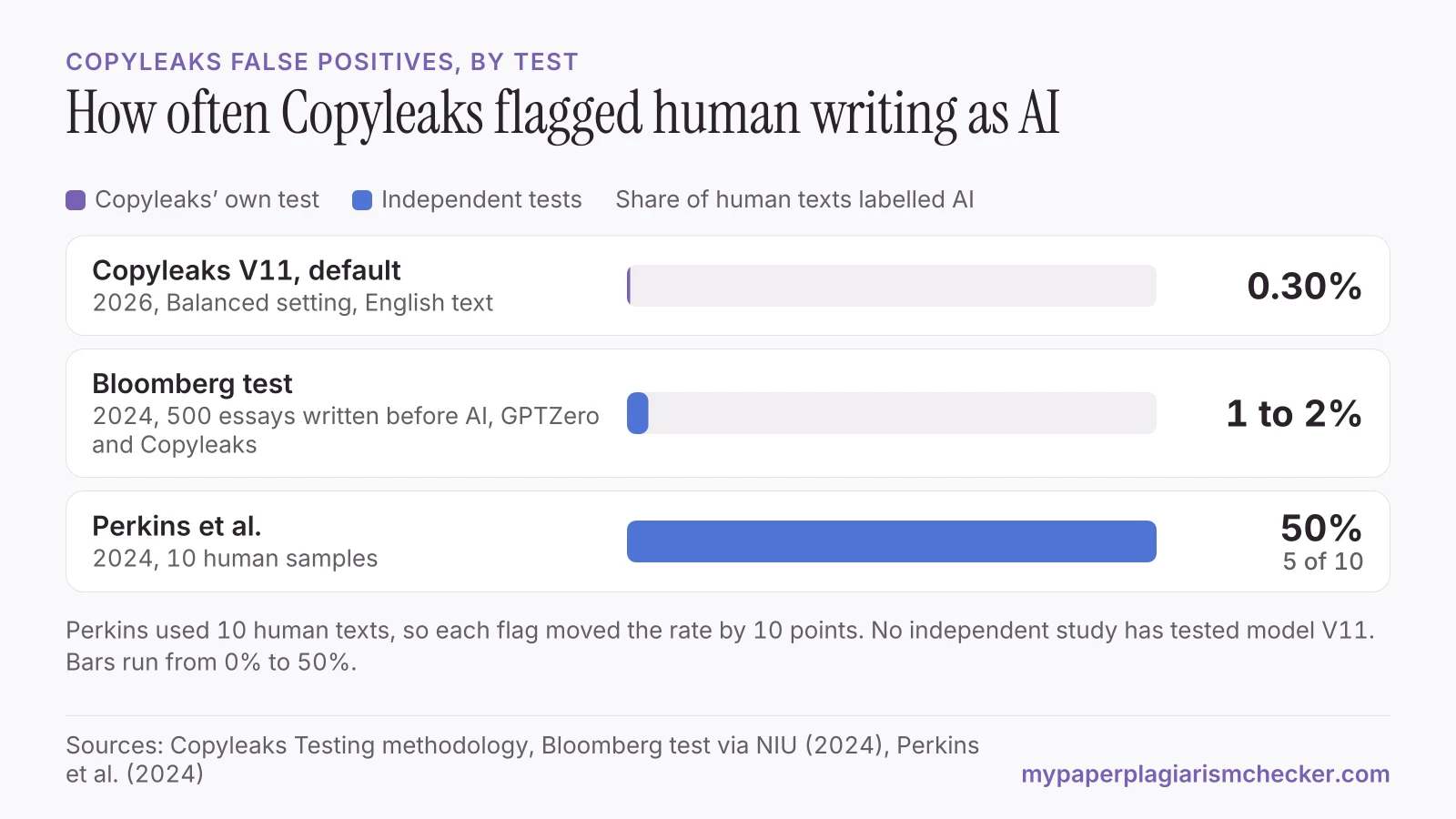
| 0.30% false positives, 0.64% false negatives | Default “Balanced” setting, model V11, tested 10 September 2026 | Testing methodology |
The V11 report is the newest and the most detailed. Two Copyleaks teams ran it on English texts longer than 350 characters. It marked 6 of 74,212 student essays and 15 of 51,765 scholarly papers as AI by mistake. Copyleaks also says the detector “currently detects essay prompt style writing. Songs and poems are not supported.”
Copyleaks says it supports over 30 languages. Its own figures for English are 99.97% correct on human text and 99.20% on AI text, with lower AI figures for French, German, Italian, Portuguese and Spanish.
The school's sensitivity setting changes the error rate
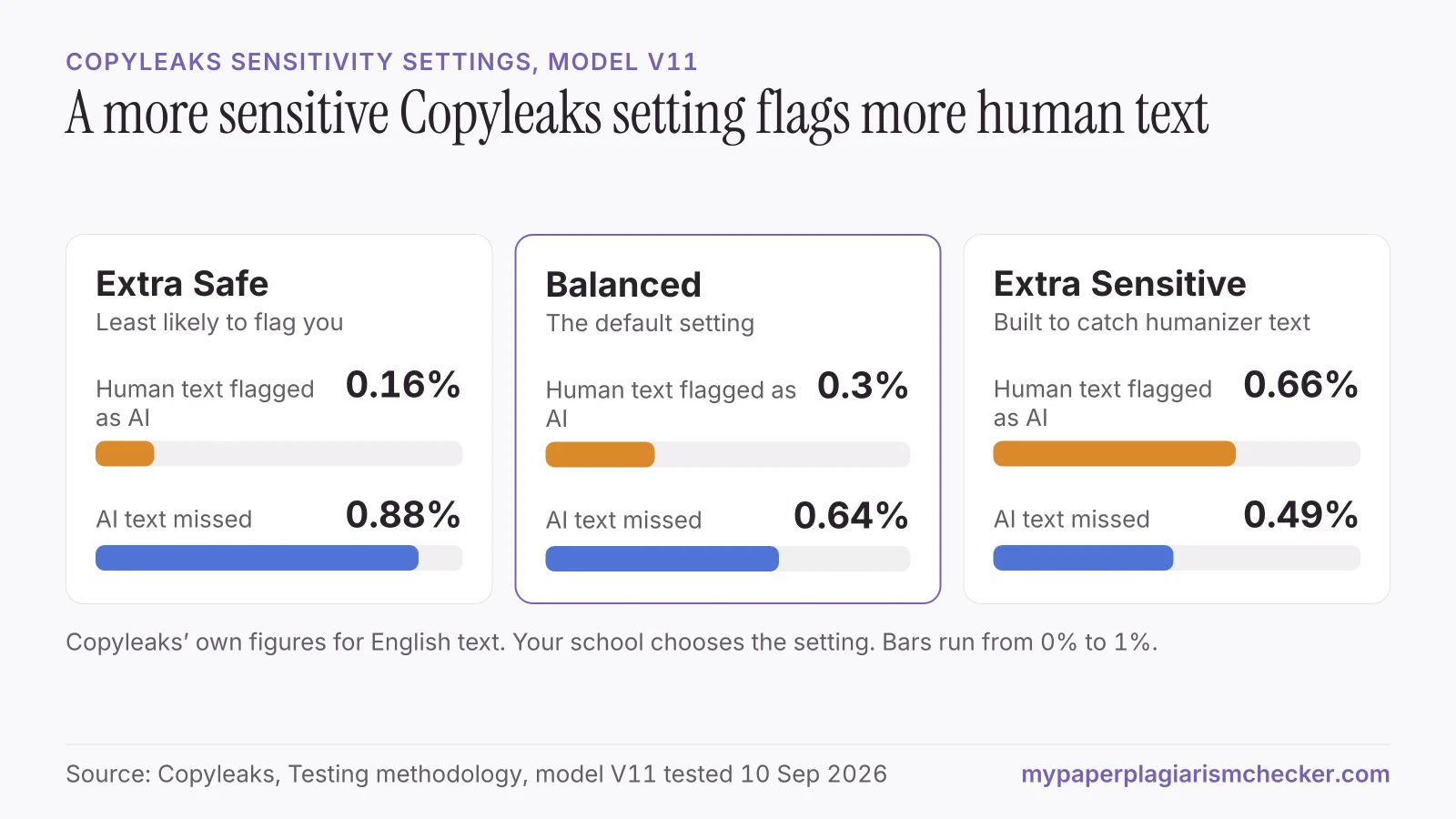
Copyleaks has three sensitivity levels and lets organizations “Fine-tune detection thresholds”. Its V11 report gives these rates for each level.
| Setting | Human text flagged as AI | AI text missed |
|---|---|---|
| Extra Safe | 0.16% | 0.88% |
| Balanced (default) | 0.30% | 0.64% |
| Extra Sensitive (built to catch “humanizer” text) | 0.66% | 0.49% |
These are Copyleaks' own numbers. Copyleaks also writes: “False positives can and do happen with every AI detector.” Source: The Do's and Don'ts You Need To Know Before Utilizing AI Detectors.
What independent tests found
Independent studies rank Copyleaks among the stronger AI detectors. They also found human writing flagged as AI, and they tested older versions on small samples.
| Study | What was tested | What it found for Copyleaks |
|---|---|---|
| Walters (2023) | 16 detectors. 42 essays by first-year composition students and 84 written by ChatGPT-3.5 and GPT-4 | One of three detectors, with Turnitin and Originality.ai, that had high accuracy on all three sets of essays. |
| Elkhatat et al. (2023) | 5 detectors, including Copyleaks. 30 AI paragraphs and 5 human-written controls | Across the tools, human controls got false positives and uncertain results. The false positives the study names came from other tools. |
| Perkins et al. (2024) | 7 detectors. 114 samples, including 10 human-written controls | Most accurate of the seven: 64.8% on unedited AI text and 58.7% on AI text edited to avoid detection. Flagged 5 of the 10 human controls as AI, the highest rate of the seven. |
| Bloomberg test, reported by Northern Illinois University (2024) | GPTZero and Copyleaks on 500 essays written before generative AI | False positive rates of 1 to 2%. |
Perkins and colleagues put the trade-off plainly: Copyleaks “possessed the highest likelihood of producing false results, with 50% of human-generated samples misidentified as AI written.” Their human set was 10 texts, so each flag moves that rate by 10 points. Elkhatat and colleagues conclude that detectors “should not be used as the sole determinant in academic integrity cases.”
None of these studies tested the V11 model from September 2026. ZeroGPT was in the same 2024 study. For its results, see is ZeroGPT accurate.
Why is Copyleaks saying my work is AI?
Copyleaks flags text that departs from the human writing patterns it was trained on. Some real writing does, and some parts of a paper get highlighted because of how Copyleaks scans text.
Copyleaks describes the method: it flags text “as potential generative AI when it detects deviations from known human patterns and specific AI signals.”
Headers, titles and references
Copyleaks scans text in overlapping sections, and says this “could explain why things like headers, references and titles may be highlighted.”
Grammarly rewrites
Copyleaks says Grammarly's AI-based rewriting features may trigger detection. Basic grammar and spell-check typically do not.
Non-native and neurodiverse writers
Copyleaks says their writing styles “can occasionally mimic patterns misconstrued as AI-generated.”
A sensitive setting
On Extra Sensitive, Copyleaks' own false positive rate is 0.66%, more than twice the default.
Short text
The web platform needs at least 255 characters. Copyleaks says: “More characters improve detection confidence.”
Cover pages and templates
A student reports a cover page flagged at 100%. In the LMS, teachers can exclude template text from a scan.
The University at Albany warns teachers that false positives “are particularly likely to affect English language learners.” For more on this, see AI detector for ESL students, AI checker after Grammarly edits and why your writing is flagged as AI.
Copyleaks at school vs the free Copyleaks checker
At school, Copyleaks runs inside your learning platform with settings your school and teacher choose. The free checker on copyleaks.com is a separate way in, so the two can give different results.
| At school, in your LMS | Free web checker | |
|---|---|---|
| Where it runs | Canvas, Brightspace, Google Classroom, Moodle, Blackboard, Schoology, Sakai or Edsby | copyleaks.com, a browser extension or a Google Docs add-on |
| Who sets it up | Admins decide which scan settings are universal. Teachers adjust settings per assignment. | You paste your text. File scans are exclusive to the platform. |
| How much text | Set by your school's plan | Up to 25,000 characters without logging in. A free account adds monthly credits. |
| Who sees the report | Your teacher, and you if your teacher grants student access | You |
Copyleaks connects to learning platforms through LTI 1.3 and says it is used by “100,000+ institutions” in their LMS. It also says: “Copyleaks does not decide whether misconduct occurred.” Your teacher reads the report and decides. Source: Copyleaks LMS integrations.
If your school switched from Turnitin to Copyleaks
Some schools have moved. SMU's IT office announced: “This term will be the last for Turnitin.” Its Copyleaks setup is “built on the familiar Canvas interface” and turned on “on a per-assignment basis in Canvas” (SMU IT Connect). If your school made the same move, these questions help.
Ask which checks are on
Settings are chosen per assignment. Ask whether AI detection, plagiarism matching or both run on yours.
Ask what score is a problem
Copyleaks tells teachers to ask their admins about AI score thresholds. Ask your teacher which number they use.
Ask if you can see the report
Teachers decide how much student access to grant. If you can see it, you can check what was highlighted.
Expect new numbers
Copyleaks and Turnitin are different tools. Last term's Turnitin scores are not a guide to your Copyleaks scores.
Keep your drafts
Version history, notes and outlines show how you wrote the paper if a score is questioned.
To check your paper for plagiarism and AI before you hand it in, see our Turnitin alternative for students.
What students report about Copyleaks
Some students see Copyleaks flag work they wrote. Others see it clear work that other detectors flagged.
“My professor requires under 40% on turnitin and under 40% on CopyLeaks. Of course my copyleaks score was 47%.” The same student adds: “Even my references got flagged.”
“Schools just switched from Turn it to Copyleaks and it's horrible!” An outline was “Flagged 100% to include the cover page.”
On one 1,900-word essay: “Copyleaks Analysis Report: 0%”, “GPTZero: 100% AI”, “Originality.ai: 89% AI”.
“Even though we can't check before we submit. It's a gamble.”
These are single cases. They match the studies: Copyleaks ranks well overall and still flags some human writing, including references and cover pages.
What to do if Copyleaks flags your own writing
Ask to see the report, check what was highlighted, and bring your drafts to a talk with your teacher.
Ask to see the report
Your teacher controls student access. Seeing the highlights tells you which parts were flagged.
Check what was highlighted
Copyleaks says headers, references and titles can be highlighted because of how it scans text. Point these out.
Bring your drafts
Version history in Google Docs or Word, your notes and your sources show how the paper was written.
Point to Copyleaks' own guidance
Copyleaks tells educators to use the AI report “as one data point” and to talk with the student.
“We encourage educators to use the AI report as one data point to discuss how a student might have worked on the assignment.”
If you have already been accused, see what to do if you are falsely accused of using AI.
Checking your paper before you submit
My Paper Plagiarism Checker runs an AI check and a plagiarism check on the same paper and highlights the sentences that read as AI-written.
It uses its own model, so its score will not match Copyleaks or your school's settings. Read each highlighted sentence before you change it. You can run the AI check alone with the AI detector for students, or read how we check papers. My Paper Plagiarism Checker is not affiliated with Copyleaks.
FAQs about Copyleaks accuracy
Is Copyleaks as accurate as Turnitin?
In independent tests the two were close. Walters (2023) put both among the three most accurate of 16 detectors. Perkins et al. (2024) measured 64.8% for Copyleaks and 61% for Turnitin on unedited AI text. In that study Copyleaks flagged 5 of 10 human samples as AI, and Turnitin flagged none.
Is Copyleaks more accurate than ZeroGPT?
On AI text, yes, in the one study here that tested both. Perkins et al. (2024) measured 64.8% for Copyleaks and 46.1% for ZeroGPT. On human text the result went the other way: ZeroGPT flagged none of the 10 human samples, and Copyleaks flagged 5.
Is Copyleaks accurate for academic writing?
Copyleaks' own V11 test marked 6 of 74,212 student essays and 15 of 51,765 scholarly papers as AI by mistake. Independent studies of real student writing are smaller and older. Walters (2023) found high accuracy on 42 first-year composition essays. Perkins et al. (2024) found 5 of 10 human samples flagged.
Why is Copyleaks saying my work is AI?
Copyleaks flags text that departs from the human writing patterns it knows. Grammarly rewrites, non-native English and short text can all trigger it. Headers, titles and references can also be highlighted, because Copyleaks scans text in overlapping sections.
Is Copyleaks free?
The web AI detector checks up to 25,000 characters without logging in, and a free account adds monthly credits. File scans need the Copyleaks platform, and the AI Logic breakdown needs a paid plan. Schools buy the LMS version through Copyleaks' sales team.
Can I see my Copyleaks report at school?
Only if your teacher allows it. Copyleaks says teachers "decide how much student access to grant." Ask your teacher before you submit.
Sources
- Copyleaks: AI Detector
- Copyleaks: Evaluating the Accuracy of the Copyleaks AI Detector (V11 testing methodology)
- Copyleaks Help Center: How accurate is the AI Detector?
- Copyleaks Help Center: AI Best Practices Guide
- Copyleaks blog: The Do's and Don'ts You Need To Know Before Utilizing AI Detectors
- Copyleaks: LMS AI and Plagiarism Checker
- Walters (2023): The Effectiveness of Software Designed to Detect AI-Generated Writing: A Comparison of 16 AI Text Detectors (Open Information Science)
- Elkhatat, Elsaid and Almeer (2023): Evaluating the efficacy of AI content detection tools in differentiating between human and AI-generated text (International Journal for Educational Integrity)
- Perkins et al. (2024): GenAI Detection Tools, Adversarial Techniques and Implications for Inclusivity in Higher Education
- Northern Illinois University CITL: AI detectors: An ethical minefield
- University at Albany: Pros and cons of AI detection
- SMU IT Connect: Copyleaks To Replace TurnitIn for Plagiarism Detection
- Student reports: public Reddit posts linked above, quoted without usernames.
Pages read 13 November 2026
Check your paper before you hand it in
Free up to 3,000 words. No card needed.