Is ZeroGPT accurate?
What ZeroGPT claims and what tests found
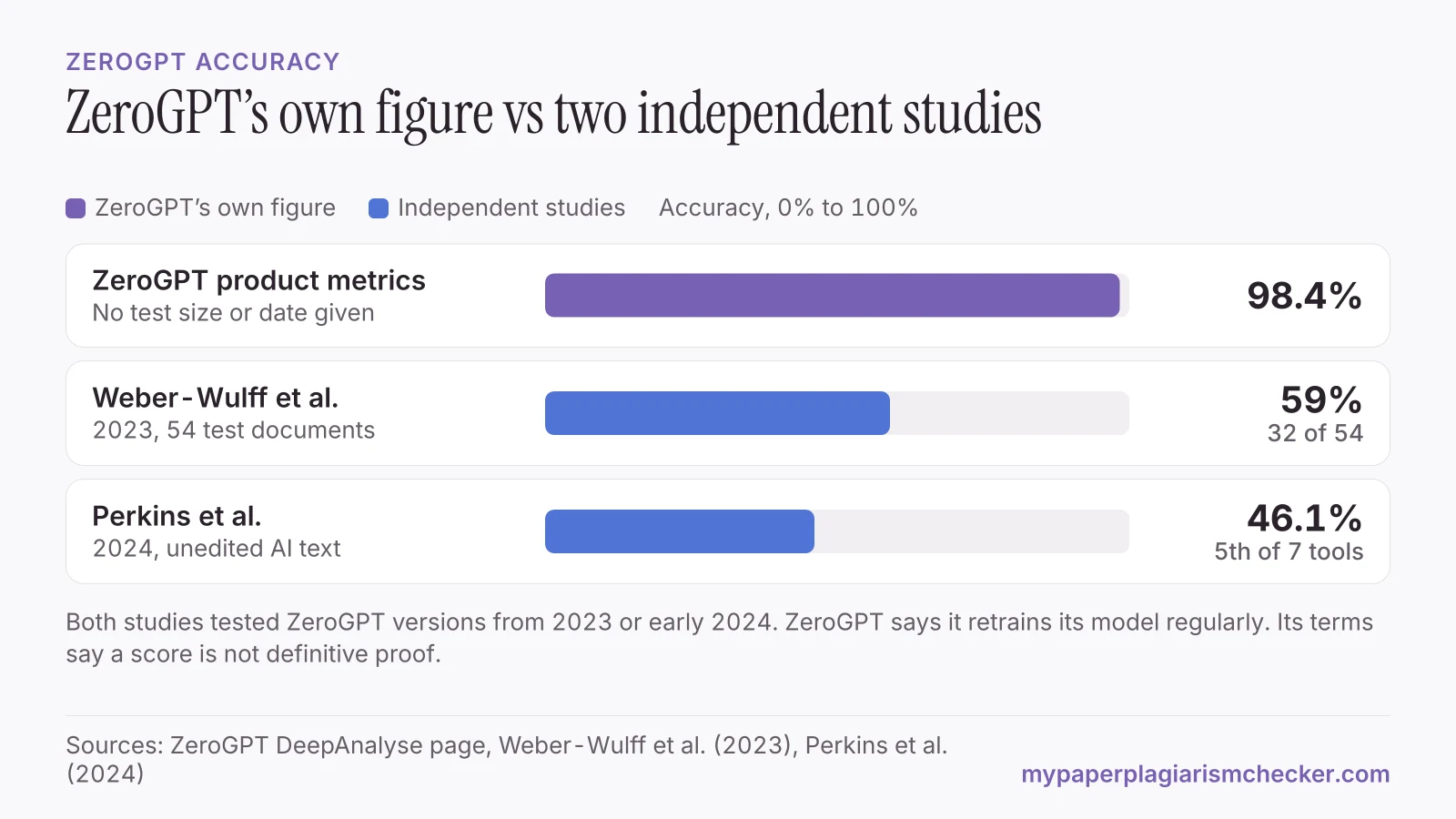
ZeroGPT is not accurate enough to prove who wrote a paper. It reports 98.4% accuracy and under 1% false positives from its own tests. Two independent studies measured 46.1% and 59% accuracy, and one large benchmark found its false positive rate changed a lot by type of writing. ZeroGPT's own terms say a score is not definitive proof.
What ZeroGPT says about its accuracy
ZeroGPT says its detector is 98.4% accurate, with a false positive rate under 1%, across more than 35 families of AI models.
ZeroGPT calls these “ZeroGPT product metrics”. Its pages do not say how many texts were tested, what kind of writing they were, or when the test ran. Its FAQ words it differently: “pushing toward >98% on internal evaluations”.
| Topic | What ZeroGPT says | Source |
|---|---|---|
| Accuracy | 98.4% Detection accuracy | DeepAnalyse Technology |
| False positives | <1% False positive rate, defined as “Human text incorrectly identified as AI” | DeepAnalyse Technology |
| Languages | All available languages are supported across all the tools. | ZeroGPT FAQ |
| Text length | At least 150 to 200 words. Longer text of 500 to 1,000 words or more improves stability. | ZeroGPT FAQ |
| Reading the result | Review the highlighted passages alongside the overall score. | ZeroGPT FAQ |
What ZeroGPT's terms say about its scores
“A ZeroGPT detection score does not constitute definitive proof that a particular person wrote, did not write, generated, or did not generate content using artificial intelligence.”
“You must not treat a ZeroGPT Output as the sole basis for a decision that could materially affect another person's rights, education, employment, admission, reputation, credit, housing, insurance, legal status, or similarly significant interests.”
Its DeepAnalyse page says the same in plainer words: “AI detection is probabilistic. A result should support human review rather than be treated as absolute proof by itself, especially in high-stakes decisions.”
What independent tests found
Published studies found ZeroGPT missed much of the AI text it was given, changed its result on a repeat run, and in one large benchmark had false positive rates that changed a lot by type of writing.
Four studies tested ZeroGPT alongside other detectors. Two used small sets of human writing. Two used larger sets.
| Study | What was tested | What it found for ZeroGPT |
|---|---|---|
| Weber-Wulff et al. (2023) | 14 detectors, 54 test documents, tested March to May 2023 | 59% accuracy (32 of 54). None of the 18 human-written documents flagged as AI. 13 of 36 AI cases missed. The same text tested twice gave different percentages. |
| Liang et al. (2023) | 7 detectors, including ZeroGPT, on 91 TOEFL essays by non-native English writers and 88 US 8th-grade essays | Across the seven detectors, an average of 61.22% of the TOEFL essays were misclassified as AI-generated. |
| RAID benchmark, Dugan et al. (2024) | Open-source detectors and four commercial ones (GPTZero, Originality, Winston, ZeroGPT) on human and AI text from several types of writing | At fixed score cut-offs, it flagged 0.90% to 1.71% of the human texts. When the researchers tuned each detector to a 5% false positive rate for each type of writing, ZeroGPT missed that target in many of them, with a rate of 52% in one. |
| Perkins et al. (2024) | 7 detectors, 114 samples including 10 human-written controls | 46.1% accuracy on unedited AI text, 5th of 7. None of the 10 human controls flagged. 73% of AI cases went undetected, including AI text edited to avoid detection. |
The results point two ways. In the two small studies, ZeroGPT flagged none of the human-written texts it saw (18 in one, 10 in the other), and missed a lot of the AI text. The RAID benchmark, with far more human text, found a low false positive rate overall at fixed cut-offs and much higher rates in some types of writing. The Liang study figure is an average for seven detectors, so it does not give ZeroGPT's own rate.
All four studies tested versions of ZeroGPT from 2023 or early 2024. ZeroGPT says it retrains its model regularly. Perkins and colleagues add that their results “may not necessarily represent the current ability of any of the listed tools.”
“We found that our detectors were capable of achieving the high accuracies cited in many viral reports, but only at similarly high FPR.”
Why is ZeroGPT flagging my writing?
ZeroGPT flags writing that looks statistically like AI output. Formal, polished or formulaic writing can look that way when you wrote every word yourself.
ZeroGPT's own FAQ answers the question: “Highly polished, formulaic, or low-entropy writing can resemble AI.”
Formal, polished style
Academic writing uses set phrases and even sentence rhythm. ZeroGPT says polished, formulaic writing can resemble AI.
Short text
ZeroGPT says it works best on at least 150 to 200 words. A short answer or one paragraph gives it less to go on.
English as a second language
A 2023 study found seven detectors, ZeroGPT among them, misclassified over half of non-native writers' TOEFL essays on average.
Citations and headings
Students report ZeroGPT highlighting in-text citations and a table of contents.
Editing tools
Students report higher AI scores after grammar or rewriting tools changed their wording.
A new score each run
A 2023 study got different percentages for the same text. Students report new scores after tiny edits.
For the wider reasons detectors flag real writing, see why your writing is flagged as AI. If you write in English as a second language, see AI detector for ESL students. If you edit with Grammarly, see AI checker after Grammarly edits.
What students report about ZeroGPT
Student posts show ZeroGPT scores that disagree with other detectors and change from one run to the next.
“GPTzero tells me my work is 100% human while zeroGPT tell me that it's 71% AI.”
“I literally just pressed the space bar to add a paragraph break and make it look cleaner and then I checked it again, and suddenly it said 100% [AI] detected.”
“ZeroGPT is flagging this paragraph that has in text citations.”
A teacher's screenshot showed “each of my 3 answers as 100% AI”. The student's own run “shows 52% on one question, 0% on another and 50% on the 3rd one.”
These are single cases. They match two findings above: results change between runs, and detectors disagree on the same text.
What to do if ZeroGPT flags your own writing
Find out which detector your school uses, keep your drafts, and read the highlighted sentences before you change anything.
Find out what your school uses
Your school may use Turnitin, Copyleaks, another tool or none. A ZeroGPT score does not tell you what those tools will say.
Keep your drafts
Google Docs and Word keep a version history. Your notes, outline and sources also show how the paper was written.
Read the highlighted sentences
ZeroGPT says to review the highlighted passages alongside the overall score. Check whether they are citations, headings or set phrases.
If a teacher used ZeroGPT
Point to ZeroGPT's terms. They say a score is not definitive proof and must not be the sole basis for a decision about your education. Offer to talk through your drafts.
If you have already been accused, see what to do if you are falsely accused of using AI.
ZeroGPT vs GPTZero
ZeroGPT and GPTZero are separate detectors with similar names, and they often give different results on the same text.
ZeroGPT's terms name its operator as Olive Works LLC, a Wyoming company. GPTZero is a different product. ZeroGPT's own DeepAnalyse page explains the disagreement: “Different AI detectors use different models, datasets and methodologies, so the same text can produce different results across different detection systems.”
The studies above do not point one way. Weber-Wulff et al. (2023) measured 59% accuracy for ZeroGPT and 54% for GPTZero, and GPTZero flagged 9 of 18 human texts where ZeroGPT flagged none. Perkins et al. (2024) measured 46.1% for ZeroGPT and 26.3% for GPTZero on unedited AI text. In the RAID benchmark, at a fixed cut-off of 0.25, GPTZero flagged 0.03% of human texts and ZeroGPT 1.71%. For GPTZero's own claims and tests, see is GPTZero accurate.
Checking your paper before you submit
My Paper Plagiarism Checker runs an AI check and a plagiarism check on the same paper and highlights the sentences that read as AI-written.
It uses its own model, so its score will not match ZeroGPT or the tool your school uses. Read each highlighted sentence before you change it. You can run the AI check alone with the AI detector for students, or read how we check papers. My Paper Plagiarism Checker is not affiliated with ZeroGPT.
FAQs about ZeroGPT accuracy
Is ZeroGPT as accurate as Turnitin?
In the studies that tested both, Turnitin scored higher. Weber-Wulff et al. (2023) measured 76% accuracy for Turnitin and 59% for ZeroGPT. Perkins et al. (2024) measured 61% and 46.1% on unedited AI text. The two use different models, so a ZeroGPT score does not tell you what Turnitin will show.
Is GPTZero or ZeroGPT more accurate?
It depends on the test. ZeroGPT scored higher than GPTZero in two academic studies from 2023 and 2024. In the RAID benchmark, GPTZero flagged fewer human texts: 0.03% against 1.71% for ZeroGPT at the same cut-off.
What percent on ZeroGPT is bad?
ZeroGPT does not publish a cut-off. It describes its gauge as showing "the percentage of AI inside the text", and its terms say a score is not definitive proof. What counts as a problem is set by your school's policy and the tool your school uses.
Is ZeroGPT safe to use?
ZeroGPT's FAQ says text you check "is not saved, shared, published online, or used to train" its detection model. It also says its infrastructure is hosted in Germany and run in line with the GDPR.
Does ZeroGPT check plagiarism?
Yes. ZeroGPT has a separate plagiarism checker. Its terms say plagiarism checking "does not guarantee identification of every existing source or similarity."
Who created ZeroGPT?
ZeroGPT's terms of use name Olive Works LLC, a limited liability company organized under the laws of Wyoming, United States, as the company doing business as ZeroGPT.
Sources
- ZeroGPT: AI Detector
- ZeroGPT: DeepAnalyse Technology
- ZeroGPT: Frequently Asked Questions
- ZeroGPT: Terms of use
- Weber-Wulff et al. (2023): Testing of Detection Tools for AI-Generated Text (International Journal for Educational Integrity)
- Liang et al. (2023): GPT detectors are biased against non-native English writers (Patterns)
- Dugan et al. (2024): RAID: A Shared Benchmark for Robust Evaluation of Machine-Generated Text Detectors (ACL 2024)
- Perkins et al. (2024): GenAI Detection Tools, Adversarial Techniques and Implications for Inclusivity in Higher Education
- Student reports: public Reddit posts linked above, quoted without usernames.
Pages read 13 November 2026
Check your paper before you hand it in
Free up to 3,000 words. No card needed.