
Academic misconduct and AI
What happens if you get caught using AI at university
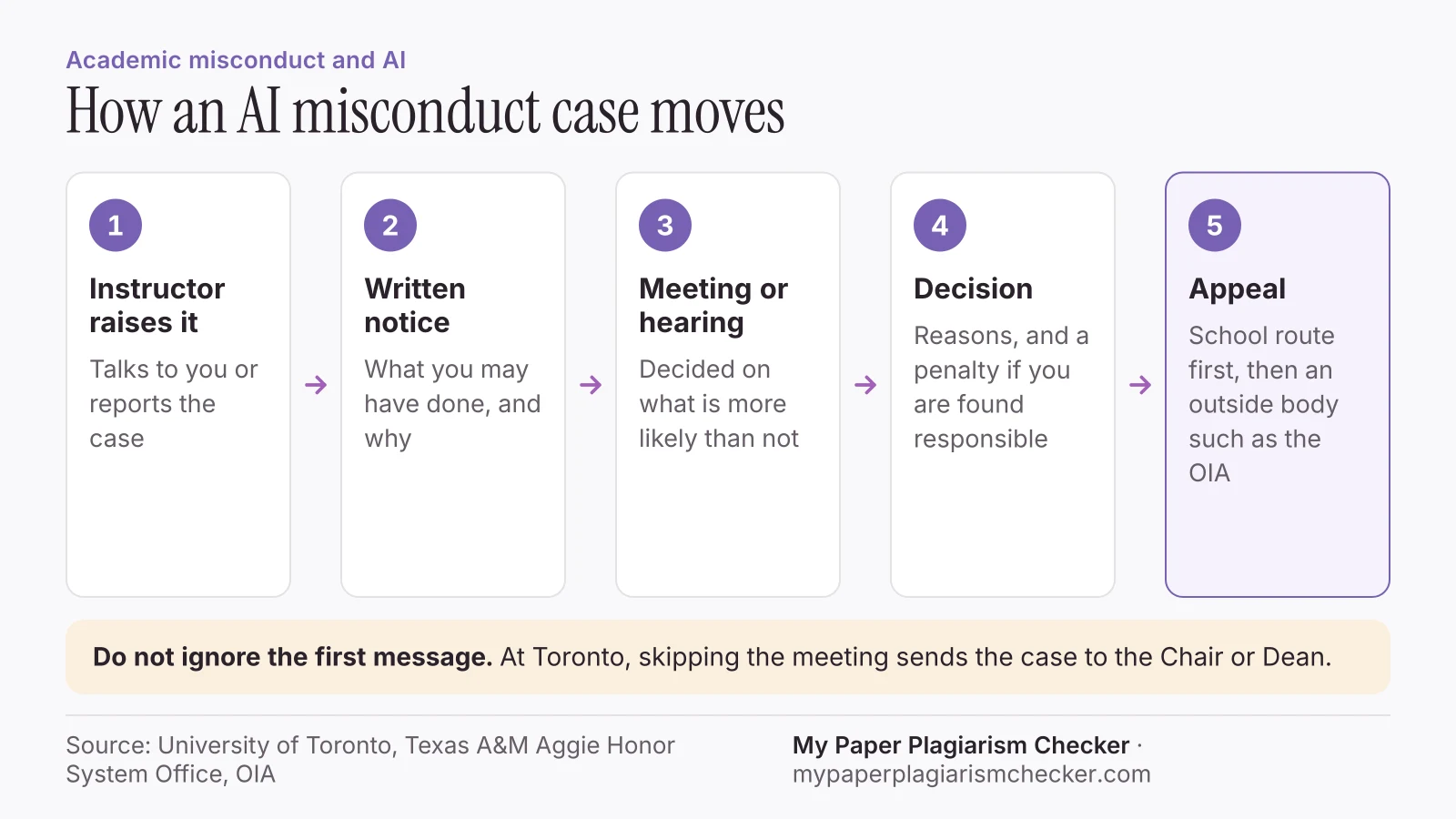
An AI misconduct case usually starts with a report from your instructor, moves to a meeting or hearing, and ends with a decision you can appeal. Outcomes range from a warning or a zero to a failed course or suspension. This guide walks through each stage using real university procedures.
How an AI misconduct case starts
A case starts when an instructor suspects AI use your course did not allow, or AI use you did not acknowledge.
What counts as misuse depends on your course policy. See is using AI cheating for where universities draw the line. Common triggers are a sudden change in writing style, sources that do not exist, a detector score, or work that does not match your earlier assignments. Stanford's policy says “Citations to sources that do not exist or other irregularities may prompt a review”. Detector scores can also flag human writing, as why is my writing flagged as AI explains.
The instructor raises it
At Toronto, the instructor “should inform you immediately and provide you with an opportunity to discuss the matter.” Toronto adds: “Nothing that you say in the discussion with your instructor may later be used as evidence against you.”
The case is reported or settled
At Texas A&M, the instructor can resolve it informally and report it, send it to an administrative conference, or refer it to the Honor Council. A student with a prior finding goes to the Honor Council automatically.
You get a written notice
The OIA, which reviews student complaints in England and Wales, says students “should be told in writing what it is that they may have done that is a breach of the assessment rules, and why the provider thinks this.”
Do not ignore the first message. Toronto warns that if you skip the meeting, “the case will be sent to the Department Chair or Dean.” At Texas A&M, you cannot drop or withdraw from the course while the case is open.
What happens at an academic integrity meeting or hearing
A person or panel looks at the evidence, asks you about the work, and decides whether misconduct is more likely than not.
| Institution | How the case is heard | Source |
|---|---|---|
| Texas A&M University (US) | At an administrative conference, you and your instructor meet an Academic Integrity Administrator, who will use the preponderance of information standard to decide whether or not academic misconduct occured.Honor Council cases go to a hearing. | What Happens Next? |
| University of Toronto (Canada) | Cases can move from the instructor to the Chair, the Dean and the University Tribunal. At the Dean's meeting, You are able to bring a support person with you, and You are not obliged to make any statement or admission. | Process and Procedures |
| OIA (England and Wales) | The responsibility is on the provider to prove that the student has done what they are accused of doing, not on the student to disprove it.Providers may decide to carry out a vivato test your understanding. | Casework note: AI and academic misconduct |
What you are likely to be asked
The content
The OIA says a viva focuses on the content of the work you submitted.
How you wrote it
Providers should let you “explain how they worked to prepare their submission.”
Notes and drafts
The OIA says it can help to ask students for copies of notes or drafts.
Your earlier work
Providers may compare the work under scrutiny to other assessed work previously completed by the student.
If you did not use AI and need to answer an accusation, follow the steps in falsely accused of using AI. That guide covers how to reply and what to bring.
What happens if you are found responsible
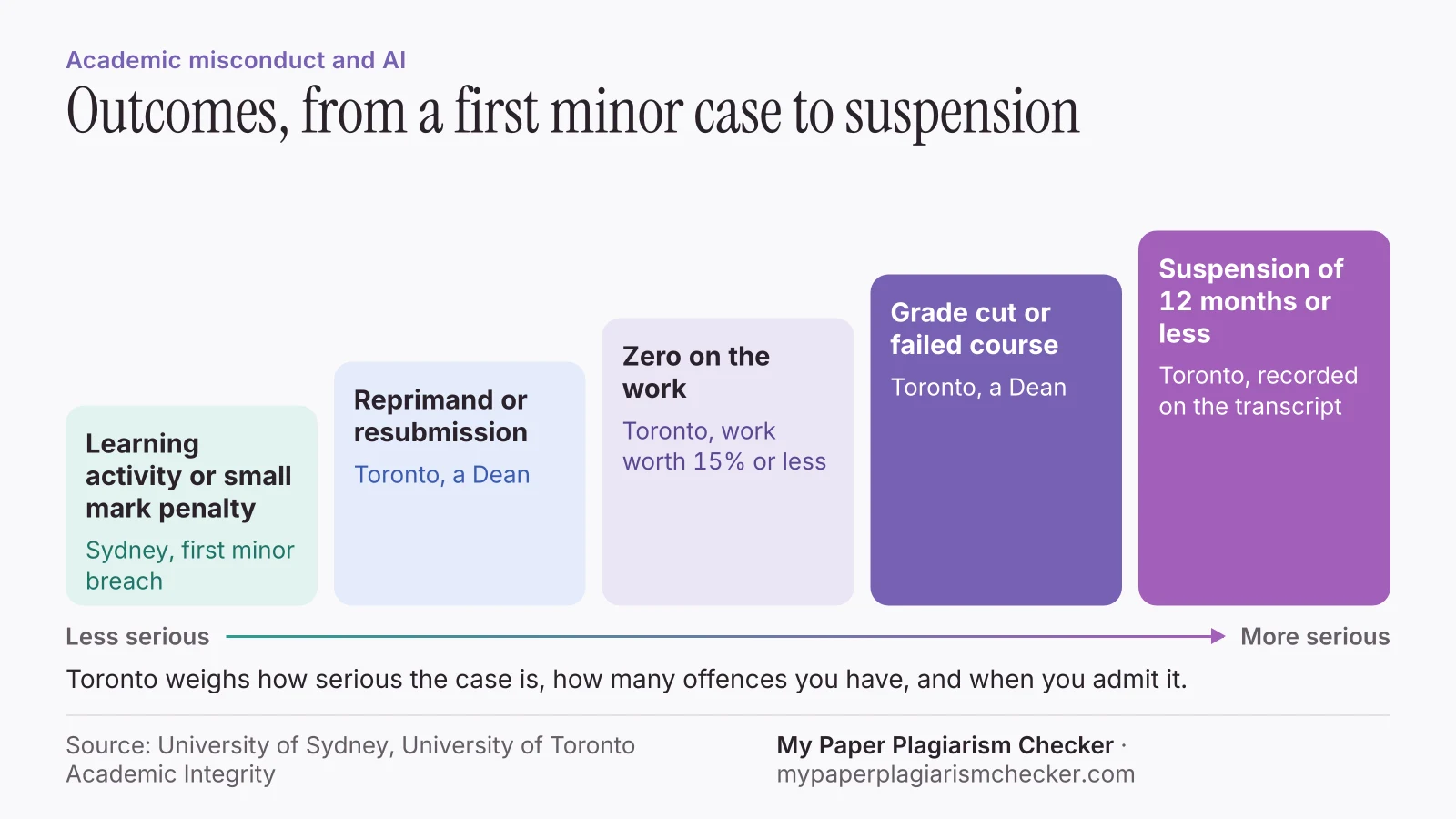
Penalties depend on how serious the case is, whether it is your first, and whether you admit it. First and minor cases often end in a lower mark or a learning activity. Serious or repeat cases can end in a failed course or suspension.
| Outcome | Example from a university procedure | Source |
|---|---|---|
| Learning activity or small mark penalty | A first case at Sydney may be a ‘minor breach’ only, and you will be directed to complete a development activity. You might also have a small mark penalty applied. | University of Sydney |
| Reprimand or resubmission | A Dean may Give an oral and/or written reprimandand, if the instructor agrees, allow the work to be resubmitted. | University of Toronto |
| Zero on the work | For work worth 15% or less, a Chair may give a Mark of zero for the piece of work. | University of Toronto |
| Grade cut or failed course | A Dean may give an overall grade reduction to the courseor a grade of zero or a fail to the course. | University of Toronto |
| Suspension and a transcript record | A Dean may suspend a student for a period of 12 months or lessand record the sanction on the transcript. Second offences go to the Provost and can reach the University Tribunal. | University of Toronto |
Toronto weighs “The context and seriousness of the offence”, “The number of times you have committed an academic offence” and “The point at which you admit to an offence”. The OIA calls an “educative rather than punitive approach for minor or first instances” good practice, and says a provider should explain why it did not choose a lesser penalty.
What happens if you get flagged for AI in high school
Your school's code of conduct decides who handles a case and what the penalty is. Exams run by an outside board follow that board's rules too.
For AP Seminar and AP Research, College Board gives students three options once work is flagged for unacceptable use of AI:
- “Voluntarily accept a score of 0 on that particular component of the performance task, and still receive an overall AP score.”
- “Voluntarily accept cancellation of the entire exam.”
- “Request a reconsideration of that particular component of the performance task.”
A reconsideration needs documents such as “Version history (e.g., Google Docs history)” and a teacher attestation. Source: AP Central. Before you submit an IWA or IRR, the AP Seminar AI checker shows which sentences read as AI-written.
In the UK, GCSE, A level and EPQ coursework falls under JCQ rules, where AI misuse is malpractice reported to the exam board. See do exam boards check NEA for AI.
How to appeal an academic misconduct decision
Toronto, College Board and the OIA all describe a route to challenge a decision or a penalty. Find your deadline on the day you get the outcome.
Read the reasons
The OIA says decision makers “should give clear reasons for their findings” and explain the penalty. Note what the decision relied on.
Use the school's own route first
At Toronto, a student unhappy with a Chair's or Dean's sanction “may refer the matter to the Provost's Office” for reconsideration. Your school's procedure names its own appeal route.
Go outside the school if needed
In England and Wales, students who have finished their university's process can complain to the OIA. It says almost all of its AI complaints come from students in a misconduct procedure, and “The number of these complaints remains low.”
What students say about AI misconduct cases
Students write in after the first email, asking what the meeting is and what the penalty could be.
“I am a 3rd-year uni student and have recently been called into my uni for the use of AI in my essay.”
“I was caught using AI to write one of my papers. I feel horrible, what now?”
“What happens to an AP student if they get accused of cheating in a class?”
“Find the universities disciplinary policy. ... You should also find out what the appeals process is.”
These come from about 1,800 student threads we collected from Reddit, Quora, The Student Room and other forums in November 2026. Threads about misconduct hearings, appeals and being caught came up in 28 Reddit threads with about 790 comments.
Where a My Paper Plagiarism Checker report fits
A report can sit next to your drafts as supporting material. No AI detector result, including ours, proves how a text was written.
Drafts, version history and notes show how you wrote the paper. See how to prove you didn't use AI for what to keep. Before your next paper, the AI detector for students highlights the sentences that read as AI-written so you can review them first.
Your paper is never sent to Turnitin or your school, so it can't match itself when you submit it there. My Paper Plagiarism Checker keeps the text with its report until you delete the report.
FAQs about academic misconduct and AI
What happens if a student gets caught using AI?
The instructor usually talks to the student or reports the case to the school's integrity office. A meeting or hearing follows, and the school decides on the balance of the evidence. Outcomes range from a warning or a zero on the work to a failed course or a suspension.
Can I get kicked out of university for using AI?
Suspension is possible in serious or repeat cases. At the University of Toronto, a Dean can suspend a student for up to 12 months, and second offences go to the Provost, who can send the case to the University Tribunal. The University of Sydney says it generally takes an educational approach when a breach comes from a lack of understanding.
What happens if you get flagged for academic integrity?
A flag starts a review. You are told what the concern is and get a chance to respond, often in a meeting. The UK's Office of the Independent Adjudicator says the provider must prove the case, not the student disprove it.
What happens if your professor accuses you of using AI?
Your professor may meet you first or report the case straight to the integrity office. At Texas A&M, the instructor can handle it informally, send it to an administrative conference, or refer it to the Honor Council. If you did not use AI, see our guide for students who are falsely accused.
What happens if you get flagged for AI in high school?
Your school's code of conduct decides who handles it and what the penalty is. For AP Seminar and AP Research, College Board lets students accept a 0 on that component, cancel the exam, or ask for reconsideration with version history and teacher notes.
Can universities check if you used AI?
Many use detection software. The UK's Office of the Independent Adjudicator says decision makers should weigh those reports carefully against other evidence. Schools also compare your work with earlier assignments, check that sources exist, and ask you to explain the work in a meeting or viva.
Sources
- Texas A&M University, Aggie Honor System Office: What Happens Next?
- University of Toronto, Academic Integrity: Process and Procedures
- University of Toronto, Academic Integrity: Key Consequences
- University of Sydney: Academic integrity breaches
- Office of the Independent Adjudicator for Higher Education: Casework note: Complaints relating to AI and academic misconduct
- College Board, AP Central: Once a student is notified that their work has been flagged for unacceptable use of AI, what options does the student have?
- Stanford University, Office of Community Standards: Generative AI Policy Guidance for Academic Use
Pages read 14 November 2026
Check your next paper before you hand it in
Free up to 3,000 words. No card needed.