Is using AI cheating?
Where schools draw the line, and how to declare AI use
Using AI is cheating when your course or assignment does not allow that use, or when you hand in AI-made work without saying so. Your syllabus or assignment brief sets the rule. This guide shows where four universities draw the line and how to cite AI in APA, MLA and Chicago.
Who decides if using AI is cheating
Your instructor or course decides. The same use of AI can be allowed in one class and banned in the next.
Most universities set a default and let each course change it. Stanford's rules say: “Instructors may determine what constitutes permissible and impermissible AI use in their courses and assignments.” UCL tells students that “instructions given in assessment briefs take precedence” over its general guidance.
“The answer of whether AI is allowed is rarely ‘yes’ or ‘no’ but instead is ‘yes, for some AI tools, for some purposes, and no, for others.’”
If your syllabus says nothing, ask before you submit. Using AI against your course rules, or hiding it, is handled as academic misconduct. To see how those cases run and what the outcomes can be, read academic misconduct and AI.
What four universities allow
All four let the course set the rule, and all four expect you to acknowledge AI use that is not plainly allowed.
| University | What its policy says | Source |
|---|---|---|
| Stanford University (US), default policy adopted October 2026 | Students may use AI to study and for surface-level editing that does not materially alter the substance, analysis, organization, or argument of the work. They may not use AI tools to create deliverables (e.g., assignments, projects, presentations, essays, reports). | Generative AI Policy Guidance |
| UCL (UK) | Each assessment is in one of three categories: AI cannot be used, AI can be used in an assistive role, or AI has an integral role. The final decision about how GenAI may or may not be used is up to the staff member setting the assessment. | Three categories of GenAI use in assessment |
| University of Sydney (Australia) | Students may use AI as a general learning aid. Your unit of study outline will have information about whether you can use AI tools for your assessments. | Academic integrity breaches |
| University of Mary Washington (US) | Is it cheating to use AI tools? It depends.AI tools should be used only with the explicit and clear permission of each individual instructor, and then only in the ways allowed by the instructor. | Artificial Intelligence (AI) Tools |
Stanford adds a rule of thumb: “If the use of a human tutor is permitted for a given task, then it is likely that the use of generative AI as described in the examples above is similarly permitted.” Under its default policy, students “must document and disclose any other uses of AI related to coursework.”
Is using AI for feedback, grammar or ideas cheating?
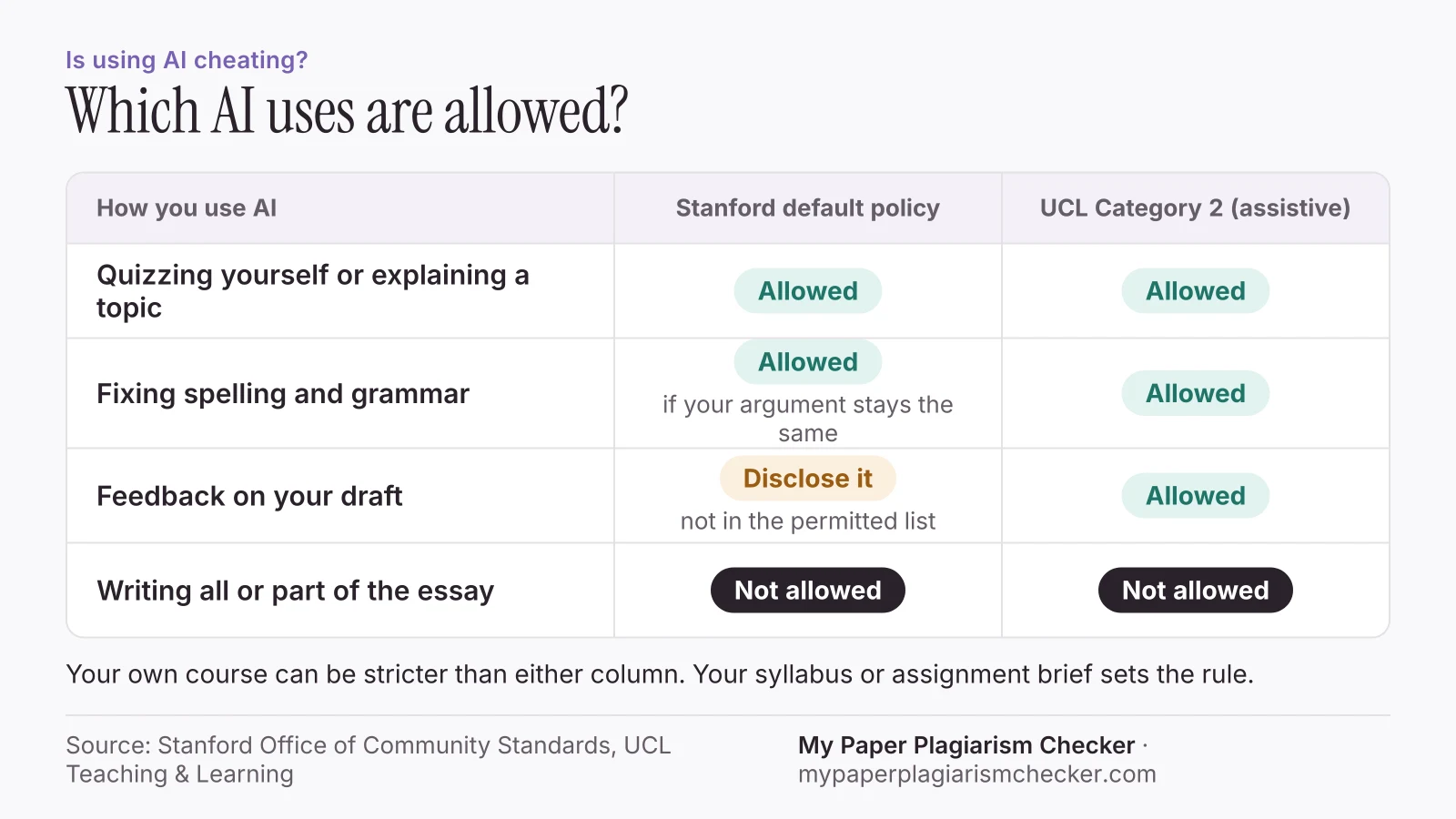
Help that supports your own writing is often allowed. AI that writes the assessed work for you is not. The table compares Stanford's default policy with UCL's assistive category.
| How you use AI | Stanford default policy | UCL Category 2 (assistive) |
|---|---|---|
| Quizzing yourself or explaining a topic | Allowed | Allowed “as a support tutor” |
| Fixing spelling and grammar | Allowed If it does not change your argument | Allowed “as a proofreader” |
| Feedback on your draft | Disclose Not in the permitted list | Allowed “giving feedback” |
| Writing all or part of the essay | Not allowed | Not allowed |
At UCL, AI that helps must not complete the assessment “entirely or only in part”, and the student “should still be the author of their own work”. Your own course can be stricter than either column.
Is using ChatGPT plagiarism?
Handing in ChatGPT's text as your own is treated as plagiarism or misconduct. UCL says: “If GenAI is misused in assessment, this is considered under the category of plagiarism or falsification.” The APA Style team says submitting AI work “as though you did it yourself” would be “academic misconduct for students”.
Whether a checker can spot AI text is a separate question. For that, see can Turnitin detect ChatGPT.
How to acknowledge AI use in an essay
Say which tool you used, what you used it for and when, in the place your instructor asks for.
Check what your course asks for
Some courses want a short statement, some a declaration form, some a citation. UCL says “Students must acknowledge GenAI use, but do not need to cite it.” APA and MLA ask for a citation when you use AI output in your text.
Name the tool and the task
Write one or two plain sentences. APA's example: “I used ChatGPT (OpenAI, 2025) to edit my paper and provide feedback on clarity and flow.”
Include small edits too
MLA asks you to “acknowledge all functional uses of the tool (like editing your prose or translating words) in a note, your text, or another suitable location.”
Keep your prompts and the replies
Sydney tells students to “keep copies of generative AI outputs as evidence of your research and writing process.” Save them with your drafts.
Check every source AI gives you
AI tools can list sources that do not exist. Stanford warns that “Citations to sources that do not exist or other irregularities may prompt a review”. Read each source and cite it directly.
A thesis or dissertation often has its own declaration page. Check your graduate school's template, and run a final check with the thesis plagiarism checker before you submit. Keeping drafts and prompts also helps if anyone later questions your work. See how to prove you didn't use AI for what to save.
How to cite ChatGPT in APA, MLA and Chicago
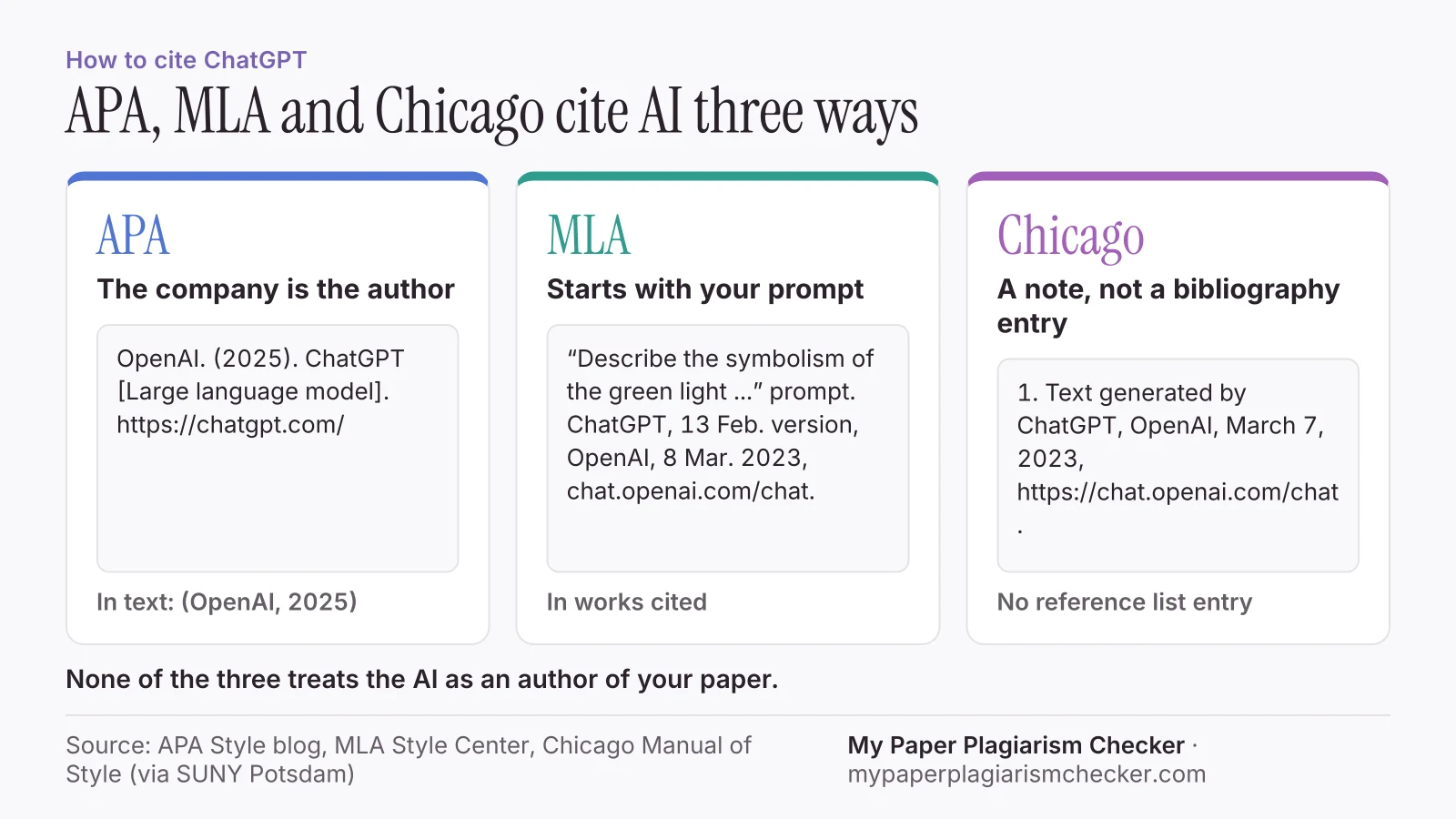
APA cites the company as author, MLA starts with your prompt, and Chicago uses a note instead of a bibliography entry. None of the three treats the AI as an author of your paper.
| Style | Official example | Source |
|---|---|---|
| APA (updated September 2025) | Reference: OpenAI. (2025). ChatGPT [Large language model]. https://chatgpt.com/ In text: (OpenAI, 2025). For a shared chat, APA uses the chat date, its title and the share link. | Citing generative AI in APA Style: Part 1 |
| MLA | Works cited: Describe the symbolism of the green light in the book The Great Gatsby by F. Scott Fitzgeraldprompt. ChatGPT, 13 Feb. version, OpenAI, 8 Mar. 2023, chat.openai.com/chat. | How do I cite generative AI in MLA style? |
| Chicago | Note: 1. Text generated by ChatGPT, OpenAI, March 7, 2023, https://chat.openai.com/chat. But don't cite ChatGPT in a bibliography or reference list. | CMOS Q&A, as reproduced by SUNY Potsdam Libraries |
APA's 2023 post on citing ChatGPT is now marked “retained for archival purposes only”, and APA no longer advises adding a version number by default. MLA says: “We do not recommend treating the AI tool as an author.” Chicago says that for most writing “you can simply acknowledge the AI tool in your text”.
GCSE, A level and EPQ students in the UK follow a different format set by JCQ: the tool name and the date, plus a saved copy of your prompts. See do exam boards check NEA for AI.
What students ask about AI and cheating
Students mostly ask where feedback ends and cheating starts, and whether declaring AI will cost them marks.
“Is using AI for essay feedback actually cheating, or is it just the modern version of asking a tutor?”
“Will you get Marked down for Acknowledging Ai”
“I used AI in several of my coursework pieces at uni ... in a way that would have been acceptable use at my uni had I ticked the right box in the declaration form.”
“Literally just add an AI disclosure statement...”
These come from about 1,800 student threads we collected from Reddit, Quora, The Student Room and other forums in November 2026. Questions about whether an AI use counts as cheating, and how to declare it, came up in 35 Reddit threads with about 1,370 comments.
Checking your paper before you submit
A pre-check shows which sentences read as AI-written and which passages match other sources, while you can still edit.
The AI detector for students highlights the sentences that read as AI-written and gives an AI score, as the sample report shows. Use it to find passages to rewrite in your own words or to mention in your AI statement. No AI detector result, including ours, proves how a text was written.
Your paper is never sent to Turnitin or your school, so it can't match itself when you submit it there. My Paper Plagiarism Checker keeps the text with its report until you delete the report.
FAQs about AI and cheating
Is using ChatGPT plagiarism?
It is when you hand in ChatGPT's text as your own words. UCL treats misused AI as "plagiarism or falsification", and the APA Style team says submitting AI work as your own would be academic misconduct for students. Using it in ways your course allows, and saying so, is not plagiarism.
Is using AI for essay feedback cheating?
It depends on your course. UCL lists "giving feedback" as an allowed use in assessments where AI has an assistive role. Stanford's default policy does not list feedback as a permitted use, so students there must disclose it. Check your syllabus or assignment brief.
Is it cheating to use a grammar checker?
Usually not, if it only fixes spelling and grammar. Stanford's default policy allows surface-level editing that does not change your argument. Generative features that rewrite your text are a different use, and some courses ban them or ask you to disclose them.
How do I acknowledge AI use in an essay?
Name the tool, say what you used it for and when, and follow your instructor's format. APA's example is "I used ChatGPT (OpenAI, 2025) to edit my paper and provide feedback on clarity and flow." Keep your prompts and the AI's replies in case you are asked.
How to use AI without cheating?
Read your course AI policy first, use AI only for the tasks it allows, write the assessed work yourself, and declare what you used. If the policy is unclear, ask your instructor before you submit.
Can ChatGPT get you in trouble for plagiarism?
Yes, if your course does not allow the use or you do not acknowledge it. Schools handle it through their academic misconduct procedure. Outcomes range from a warning or a zero to a failed course or suspension.
Sources
- Stanford University, Office of Community Standards: Generative AI Policy Guidance for Academic Use
- UCL Teaching & Learning: Three categories of GenAI use in assessment
- University of Sydney: Academic integrity breaches
- University of Mary Washington: Artificial Intelligence (AI) Tools
- APA Style blog (September 2025): Citing generative AI in APA Style: Part 1, Reference formats
- APA Style blog (September 2025): Citing generative AI in APA Style: Part 3, Is AI “allowed” in APA Style?
- MLA Style Center: How do I cite generative AI in MLA style?
- The Chicago Manual of Style Online: Q&A, Citation, Documentation of Sources (subscriber page, read as reproduced by SUNY Potsdam Libraries)
Pages read 14 November 2026
Check your paper before you hand it in
Free up to 3,000 words. No card needed.