
Do colleges check for AI in essays?
Common App, UCAS and admissions offices
It depends where you apply. The Common App treats passing off AI output as your own work as fraud, UCAS screens every personal statement for similarity, and each college decides how it reviews essays. This guide shows what each one says.
Does the Common App check for AI?
The Common App's fraud policy covers AI-written content, but it does not describe an AI detector. Colleges report suspected fraud under their own rules.
Its list of fraud includes presenting “the substantive content or output of an artificial intelligence platform, technology, or algorithm” as your own work. The full clause is quoted on our AI detector for college essays page. The policy then explains who reports fraud and who decides.
“Common App does not require members to report to us every instance of alleged Fraud, but members may do so consistent with the member's own internal fraud detection protocols.”
“Any determination made or action taken with regard to the disposition of an application by a member College and/or University for any reason is undertaken solely at the discretion and risk of the member.”
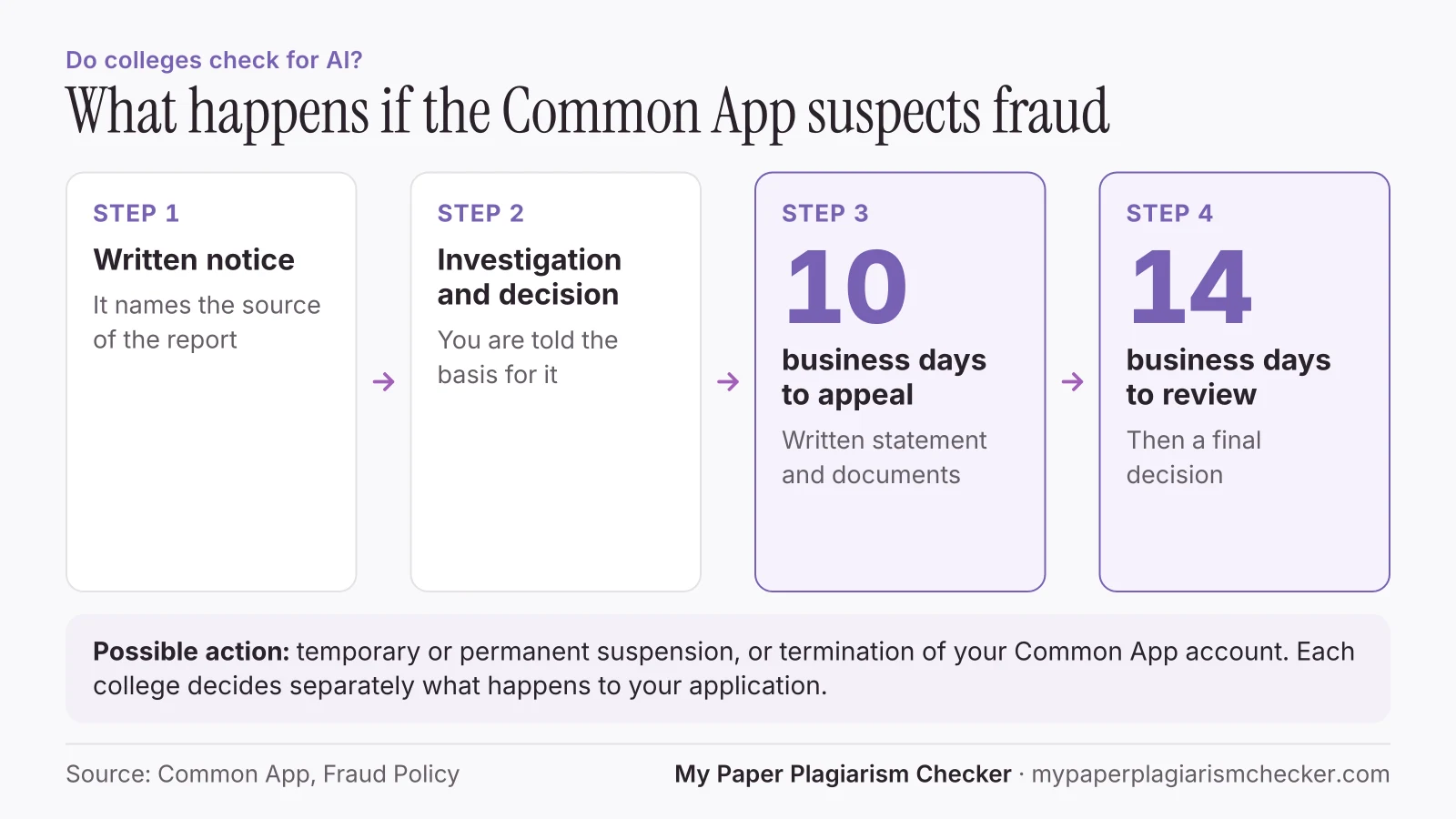
What happens if the Common App suspects fraud
Written notice
“Common App will provide written notice to the Registered User alleged of fraud.” The notice names the source of the report.
Investigation and decision
Common App may contact the college or person who reported it. If it finds fraud, it tells you and gives “the basis for the fraud determination.”
Appeal within 10 business days
You can send a written statement and supporting documents. Common App reviews them within 14 business days and makes a final decision.
Possible action
Action “may include permanent suspension, temporary suspension, or termination” of your Common App account. Each college decides separately what happens to your application.
Can UCAS detect AI?
UCAS screens every undergraduate personal statement for similarity. Its AI guide warns that text not in your own words could be flagged as fraud. The UCAS pages we read do not name an AI writing detector.
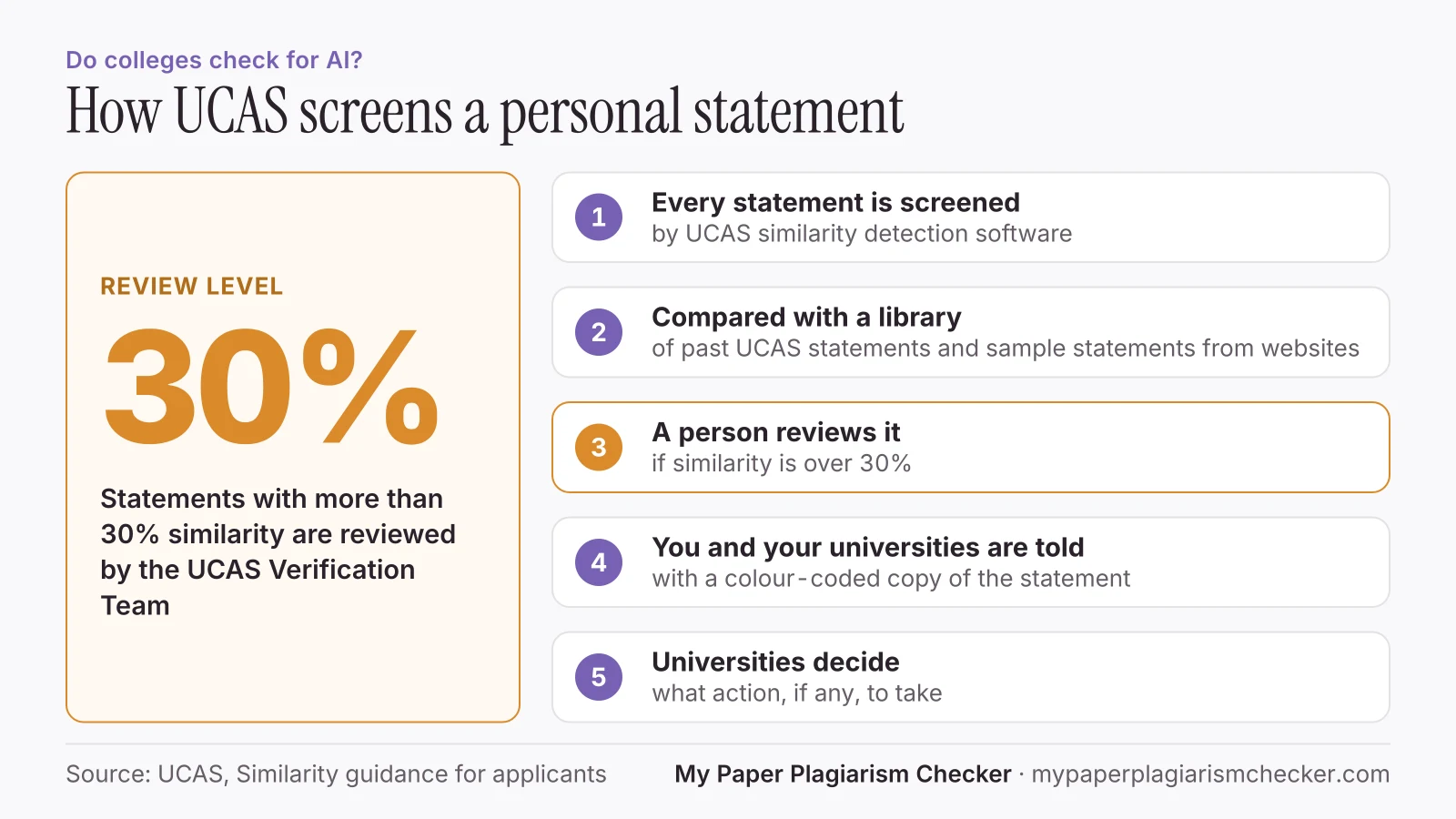
UCAS says: “All UCAS Undergraduate and UCAS Conservatoire personal statements are screened by our similarity detection software.” Its similarity guidance explains how the check works.
| Step | What UCAS says |
|---|---|
| What your statement is compared with | a library of personal statements previously submitted to UCAS, and a library of sample statements collected from websites and other sources. |
| Your statement is stored | Each personal statement received at UCAS is added to this library after it has been processed. |
| When a person reviews it | Any statements showing a level of similarity of greater than 30% are reviewed by members of the UCAS Verification Team. |
| Who is told | The applicant and their chosen universities and colleges, who get a colour-coded transcript showing the matched sentences. |
| Who decides | it is they who decide what action, if any, to take.(the universities and colleges) |
| Your earlier applications | A personal statement will not be compared to any supplied by the same applicant in previous applications. |
Source: Similarity guidance for applicants (PDF), linked from UCAS's Fraud and similarity page. Turnitin keeps papers in a similar library. See does Turnitin keep your paper.
What the UCAS AI guide says
- “Anything not in your words could get flagged as fraud by UCAS, and could in turn mean you don't receive any offers or have offers withdrawn.”
- The more applicants use ChatGPT to write statements, the more alike those statements become, and “These will then be more detectable through similarity software.”
- “We'd advise researching what individual universities and colleges recommend you include in your personal statement, and whether they have specific guidance around using AI tools like ChatGPT.”
Source: A guide to using AI and ChatGPT with your personal statement. For the UCAS declaration and how to check all three answers, see the AI detector for personal statements.
What admissions offices say about AI
Rules differ by college. Some allow AI for grammar or brainstorming, and some ban it from personal statements. None of the pages below names an AI detector.
| Admissions office | What its page says | Source |
|---|---|---|
| Caltech (undergraduate and graduate) | Failure to comply with the Ethical Use of AI guidelines may result in the rescission of your admission to Caltech.It lists Copying and pasting directly from an AI generatoras unethical, and Using AI tools, like Grammarly or Microsoft Editor, to review grammar and spelling of your completed essaysas ethical. | Admissions AI Policy |
| University of Cambridge (postgraduate) | AI must not be used when writing personal statements and CVs. This prohibition covers the use of AI to help your use of English.Also: At interview, you should expect to be asked to confirm that you are not using AI. | Using AI in your application |
| University of California (personal insight questions) | do not plagiarize from sources in print or online and do not use anyone's words, published or unpublished, but your own.The page does not mention AI. | Personal insight questions |
Caltech also lists outlining or drafting with AI and translating an essay from another language as unethical. Caltech's line sits between checking a finished essay and writing it with AI. For how schools draw the line in coursework, see is using AI cheating. Scholarship committees set their own rules too, covered in the AI detector for scholarship essays.
What applicants ask about AI checks
Applicants worry most about a detector flagging an essay they wrote themselves.
“My college counselor ran my common app personal statement through Turnitin and it flagged 30% AI. Am I cooked?”
“I'm well aware that many colleges state they don't use AI detectors for admissions but can rather tell when AI has been used.”
“Admissions teams know that AI detectors are not foolproof, and they're unlikely to flag a personal statement solely based on such tools.”
These come from about 1,800 student threads we collected from Reddit, Quora, The Student Room and other forums in November 2026. Questions about admissions checks came up most on forums, in 30 threads.
Checking your essay before you apply
Read your essay for general lines, then run an AI check to see which sentences read as AI-written.
A highlighted sentence is a reason to reread it. No detector result, including ours, proves how a text was written. Keep your drafts and notes. Your paper is never sent to Turnitin or your school, so it can't match itself when you submit it there.
Once you start college, AI checks in coursework come from tools your school adds to its learning platform. See can Canvas detect AI.
FAQs about AI checks in admissions
Does the Common App check for AI?
The Common App's fraud policy counts presenting the output of an AI platform as your own work as fraud, but it does not name an AI detector. Fraud cases start when Common App finds or receives a report of alleged fraud, and each college decides what to do with its own applications.
Can UCAS detect AI?
UCAS screens every undergraduate personal statement with similarity detection software, and its AI guide says anything not in your words could be flagged as fraud. The UCAS pages we read do not name an AI writing detector.
Do universities check personal statements for AI?
Some say how they handle it. Cambridge's postgraduate admissions bans AI in personal statements and says you may be asked at interview to confirm you are not using AI. UCAS advises checking each university's own guidance.
Can colleges really tell if you use AI?
No detector result proves how a text was written. Colleges set rules on AI use, and the pages we read describe declarations, reviews by people and interview questions rather than a named detector.
What happens if UCAS finds similarity in my personal statement?
Statements with more than 30% similarity are reviewed by the UCAS Verification Team. If they decide to report it, you and your chosen universities get an email with a colour-coded copy of your statement. The universities decide what action, if any, to take.
What happens if the Common App suspects fraud?
Common App sends you a written notice, looks into it and tells you its decision and the reason. You can appeal within 10 business days with a written statement and supporting documents.
Sources
- Common App: Fraud Policy
- UCAS: Similarity guidance for applicants (PDF)
- UCAS: Fraud and similarity
- UCAS: A guide to using AI and ChatGPT with your personal statement
- Caltech Admissions: Undergraduate and Graduate Admissions AI Policy
- University of Cambridge Postgraduate Admissions: Using AI in your application
- University of California Admissions: Personal insight questions
Pages read 14 November 2026
Check your essay before you apply
Free up to 3,000 words. No card needed.